Didier

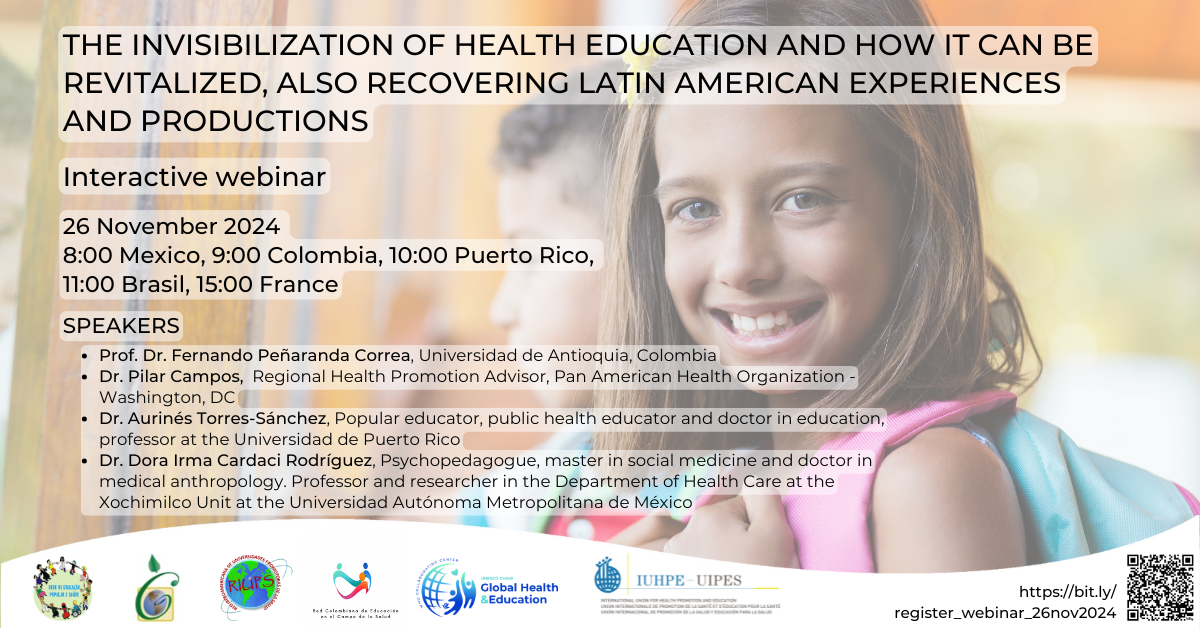
26 November 2024 – Webinar: The invisibilization of health education and how it can be revitalized, also recovering Latin American experiences and productions

26 November 2024 – Webinar: The invisibilization of health education and how it can be revitalized, also recovering Latin American experiences and productions

Time: 8.00 Mexico, 9.00 Colombia, 10.00 Puerto Rico, 11.00 Brasil, 15.00 France

Language: The webinar will be held in Spanish. Translation will be available in 50+ languages, including English, French, Portuguese and Spanish. We will use a translation app based on AI.

Link to register. Registration is free. The link to the webinar will be sent to you after registration.

Información en español, Informações em português

Speakers

Dr. Pilar Campos is Regional Health Promotion Advisor at the Pan American Health Organization (PAHO), Department of Family, Health Promotion and Life Course, Unit for Health Promotion and Social Determinants.

Dr. Aurinés Torres Sánchez is a Popular Educator, public health educator and doctor in education with more than 30 years of experience in community health programmes with vulnerable populations. Her work is characterised by the exploration and practice of theoretical and practical foundations for liberating and decolonising methodologies and curricula, and by promoting transdisciplinary approaches inspired by Buen Vivir. Its community and academic practice in decolonising public health aims to achieve collective health with dignity for all, guided by the defence of human rights and social, racial and gender justice. Among her diverse contributions, she co-created the first Boricua Model for the Training of Community Health Promoters that uses Popular Education to promote community development and empowerment towards a dignified and decolonial collective health. In 2019, she founded ‘Aula Comunitaria PR’ which provides formative and investigative accompaniment in decolonial health to individuals and groups that assume community leadership in the archipelago of Puerto Rico. Aurinés is a university professor of courses in public health, popular health education, community health, participatory action research and curriculum design at the University of Puerto Rico, Medical Sciences, Cayey and Río Piedras campuses. She is currently president of the Board of Directors of La Colmena Cimarrona in Vieques and a member of the Puerto Rico Agroecology Trust. Dr. Torres Sánchez has presented her work at scientific conferences and community-based meetings in the local and international community and participates in social justice movements in Latin America, Puerto Rico and the USA.

Dr. Dora Irma Cardaci Rodríguez graduated from the Faculty of Philosophy and Literature, University of Buenos Aires, Argentina, from the Master’s Degree in Social Medicine, Universidad Autónoma Metropolitana-Xochimilco and from the PhD in Anthropology, Medical Anthropology, National School of Anthropology and History, Mexico. She is currently a Full-Time Professor-Researcher in the Department of Health Care, Universidad Autónoma Metropolitana Xochimilco, Mexico. She has been appointed as a National Researcher Level 2, by the National System of Researchers. In 2007 she was elected Vice-President for Latin America of the International Union for Health Promotion and Education (IUHPE), a position she held until 2010. She was deputy editor of the journal Global Health Promotion, and a member of the Editorial Board of Review of Health Promotion and Education on Line. She has served as a temporary consultant to UNICEF, PAHO, UNESCO and UNFPA on health education and promotion, medical education and health and gender.

Moderator

Prof. Dr. Fernando Peñaranda Correa is a medical doctor. Master’s in public health, master’s in education and social development and doctor in Social Sciences, Childhood and Youth. He is a professor and senior researcher of the Health and Society Research Group of the National School of Public Health of the University of Antioquia. He is the coordinator of emphasis in health education of the master’s in public health. He has been a professor in the undergraduate and graduate programs of the Faculty and in other universities in the country, in the following topics: epistemology, qualitative research, ethics and social justice, public health, health promotion and health education. He has written numerous articles, book chapters and books in the areas of health education, qualitative research, ethics and public health and social justice.


Summary

The questions that will be addressed during the webinar are:

  1. What is the relevance and role that has been given to health education in health systems, in academia and in the activities of the civil society/community?
  2. What actions are being taken at the level of health systems, academia and civil society/community to revitalize health education?

Latin American Program to promote health education

This webinar is a part of the “Latin American Program to promote health education.  This initiative is being promoted with the participation of the UNESCO Chair in Global Health and Education, the Inter-American Consortium of Universities and Training Centers for Health Education and Health Promotion (CIUEPS), the Brazilian Network of Popular Health Education, the Colombian Network of Health Education and the International Union of Health Promotion and Health Education (IUHPE), with the following objectives:

  • Promote health education at national and international levels, as a fundamental dimension of the health disciplines, the educational sciences and the social and human sciences.
  • To recuperate the Latin American production and position it in the regional level, which implies promoting its critical and decolonial approaches. A health education that advocates for social transformation towards a more just and equitable society that guarantees well-being and a life with dignity.
  • Promote the articulation of the education and health sectors to strengthen the actions of each of these sectors to promote health education, by recognizing education and health as two inalienable, synergistic and interdependent human rights.
  • Strengthen the theoretical, political and ethical foundations of health education as a requirement for a responsible, productive and ethical pedagogical praxis.
  • To generate a setting for the articulation of academia and civil society that allows Latin American integration in order to share experiences, knowledge and aspirations framed in a collective purpose.
  • To promote national and international integration with respect to health education as a means for mutual learning and solidarity, and to facilitate cooperative actions in the development of academic-scientific events, research and training processes.

The webinars, open to all interested stakeholders, are a component of the program. They are experiential sessions, lasting 60-90 minutes, with guest speakers who present their reflections on two or three problematic questions to encourage audience participation. Five webinars have been scheduled for this first stage of the program, with an interval of 2 months between each one.

Posted by Didier in News
SHE inventory about implementation monitoring of the HPS approach

SHE inventory about implementation monitoring of the HPS approach

The Implementation Team of the Schools for Health in Europe (SHE) Research Group invites those who are engaged in health promotion in schools to participate in an inventory. The aim of the inventory is to explore the state of the art within countries/regions with regard to instruments to monitor/evaluate the implementation of the Health Promoting School (HPS) approach. The survey is available in English and French (you can choose the language with the options on the top right). You can answer in English, French or in your first language.

You can find the survey at this link: https://psicologiaunimib.qualtrics.com/jfe/form/SV_3n6ClB2LRRjqHKm

Monitoring the implementation of the HPS approach

The inventory constitutes a first step in researching the topic of implementation in different countries/regions. Sharing experiences about implementation practices among professionals, researchers, and policymakers is fundamental to fostering health promotion in schools. The results will help identify existing published and unpublished evaluation/monitoring instruments and standards, promote collaboration, and offer the possibility of adapting and developing shared instruments. We invite professionals, policy makers and researchers from all over the world to share the instruments used in their countries.

SHE Research Group Implementation Team

The SHE Research Group Implementation Team is part of the Schools for Health in Europe (SHE netork). The SHE Research Group aims to foster research and share development processes for health promotion in schools, as well as practices, experiences, and evidence-based interventions. The Implementation Team consists of: Veronica Velasco, Stefano Delbosq, Kathelijne Bessems, Patricia van Assema, Anne Torhild Klomsten, Karina Leksy and Kevin Dadaczynski.

More information:

Posted by Didier in News
Portuguese national launch event – 12 November 2024

Portuguese national launch event – 12 November 2024

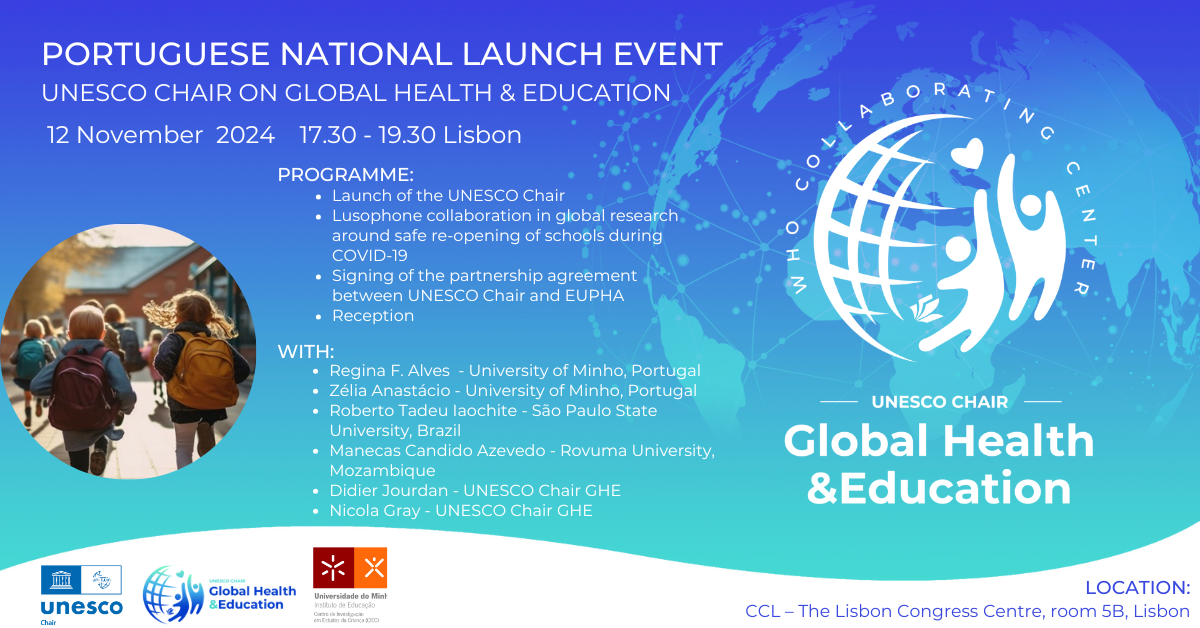
We are pleased to invite you to attend the Portuguese launch event of the UNESCO Chair on Global Health & Education. The launch event will take place on 12 November 2024 from 17.30 – 18.30, followed by a reception, during the 17th European Public Health Conference in Lisbon, Portugal.

The main aim for this meeting is:

  • to introduce the UNESCO Chair Global Health & Education;
  • to highlight the collaborative research with University of Minho, Portugal, São Paulo State University, Brazil and Rovuma University, Mozambique on the safe re-opening of schools during COVID-19;
  • to sign the partnership agreement between the UNESCO Chair and EUPHA.

The launch event is organised in collaboration with the Research Centre on Child Studies (CIEC), Institute of Education, University of Minho.

Programme

Moderator: Nicola Gray, Chair holder UNESCO Chair Global Health & Education

17.30   Welcome

  • Regina F. Alves, Zélia Anastácio and Goof Buijs

17.35    Launch of the UNESCO Chair Global Health & Education

  • Zélia Anastácio – Assistant Professor, Research Centre on Child Studies (CIEC), Institute of Education, University of Minho, Portugal.
  • Didier Jourdan – Chairholder UNESCO Chair Global Health & Education, University of Clermont Auvergne

17.45    Presentation – insights from the Lusophone collaboration in the UNESCO Chair global research project around the safe re-opening of schools during COVID-19

  • Roberto Tadeu Iaochite – Associate Professor at the Department of Education, São Paulo State University – UNESP in Brazil.
  • Manecas Candido Azevedo – Rovuma University, Mozambique (recorded message)
  • Regina F. Alves – Researcher, PhD, Research Centre on Child Studies (CIEC), Institute of Education, University of Minho, Portugal.

18.10    Interaction with participants

18.25   Signing of the partnership agreement between the UNESCO Chair and EUPHA

  • Iveta Nagyova – EUPHA President, PJ Safarik University, Department of Social and Behavioural Medicine, Kosice, Slovakia
  • Tit Albreht – EUPHA President, Scientific Co-Ordinator, National Institute of Public Health of Slovenia
  • Charlotte Marchandise – EUPHA Executive director, Utrecht, Netherlands
  • Didier Jourdan – Chairholder UNESCO Chair Global Health & Education, University of Clermont Auvergne

18.30 – 19.30    Reception

Language

This launch event will be held in English.

Location

CCL – The Lisbon Congress Centre, Room 5B

Posted by Didier in News
Establishing the effectiveness of complex health promotion interventions: Shining light on alternatives  – 12 November 2024

Establishing the effectiveness of complex health promotion interventions: Shining light on alternatives  – 12 November 2024

Pre-conference of the 17th European Public Health Conference

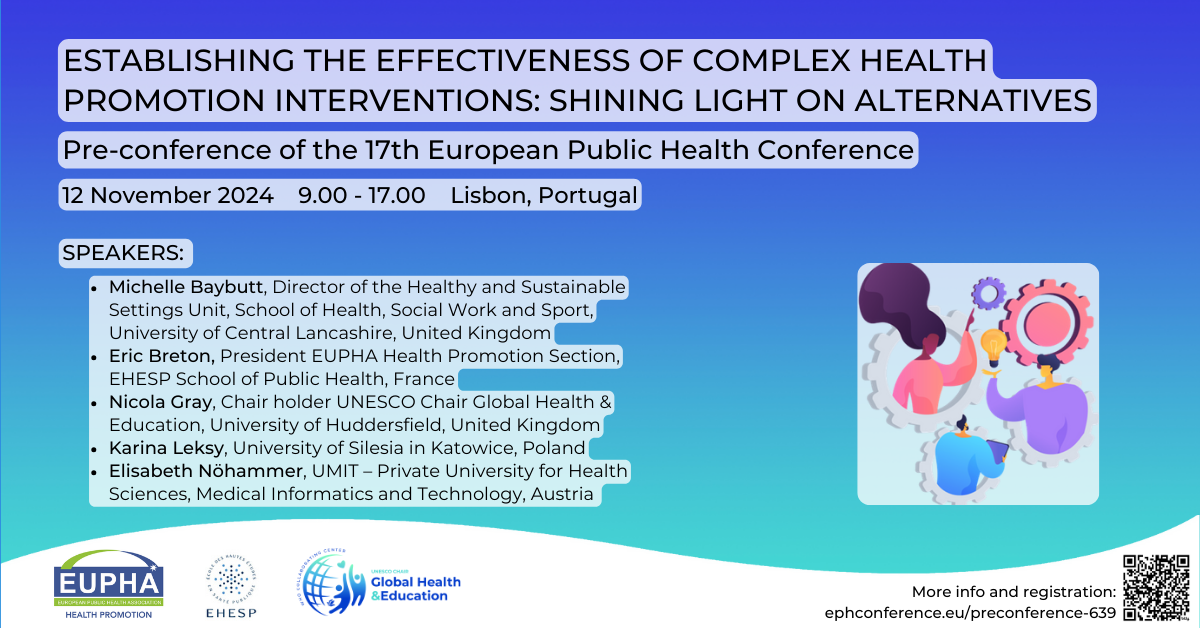
On 12 November 2024 from 9.00 – 17.00 the EUPHA Health Promotion section, in collaboration with the UNESCO Chair on Global Health & Education, are organising the pre-conference “Establishing the effectiveness of complex health promotion interventions: Shining light on alternatives”.

Background

A large share of the programmes and policies developed by field workers to cater to the specific needs of local populations are not amenable to the evaluation methods and designs which are typically ranked at the top of the evidence pyramid and usually seek to study only one factor at a time, all other things being equal. This is a major impediment to the development and improvement of local programmes that are accounting for the specific resources and barriers found locally and that adopt a participatory strategy. In this pre-conference, we will reflect on the challenges facing health promotion practitioners and researchers in establishing the effectiveness of their programmes and policies and will explore alternatives to the traditional epistemological and methodological perspectives.

Through presentations on the epistemological and methodological perspectives driving new evaluative approaches, discussions on real-life experiences, and small-group activities, this interactive preconference will offer a wealth of ideas and knowledge to public health professionals, researchers and policy makers and provide them with opportunities to build collaborations and expand their networks. Materials presented during this pre-conference and the consensus built among the participants will feed into the writing of a statement to be disseminated through the channels and networks of the organisers. This event is building on the Global Handbook of Health Promotion Research initiated by the UNESCO Chair Global Health & Education.

Speakers

The following speakers will be involved in this pre-conference:

  • Elisabeth Nöhammer, UMIT – Private University for Health Sciences, Medical Informatics and Technology, Austria
  • Eric Breton, President of the EUHPA Health Promotion Section, EHESP School of Public Health, France
  • Goof Buijs, manager UNESCO Chair Global Health & Education, The Netherlands
  • Karina Leksy, Institute of Pedagogy, Faculty of Social Sciences, University of Silesia in Katowice, Poland
  • Michelle Baybutt – Professor of Health and Justice, Director of the Healthy and Sustainable Settings Unit, School of Health, Social Work and Sport, United Kingdom
  • Nicola Gray, Chairholder UNESCO Chair Global Health & Education, Reader at the University of Huddersfield, United Kingdom
  • Silvia de Ruiter, project officer UNESCO Chair Global Health & Education, The Netherlands

More information and registration

For more information please see the EPH conference website.

Registration for the pre-conference is € 150,-.

Posted by Didier in News
Call for posters – Share your initiatives for health and well-being promotion of education professionals

Call for posters – Share your initiatives for health and well-being promotion of education professionals

To celebrate the 15th anniversary of Education and Solidarity (ESN) and in light of the conclusions of I-BEST 2023 and the importance of promoting the well-being of education professionals, ESN and UNESCO Chair “Global Health and Education” (GHE) are launching the “I-BEST Poster Awards” to collect your initiatives and good practices for health and well-being promotion.

3 initiatives in particular will receive awards and financial support.
For more details, please see:

  1. The call for participation and associated prices
  2. A poster template

We strongly encourage you to share the initiatives of your organization with an international audience. Send your contribution, no later than July 9, 2024, to the following address: secretariat@educationsolidarite.org

The selected posters will then be exhibited online on ESN and its partners’ websites from the 3rd week of July, and physically at the I-BEST Solutions Forum on July 27 in Buenos Aires.

Posted by Didier in News
<strong>Publication – The Lancet Child & Adolescent Health: A renewed commitment to intersectoral action for child and adolescent health</strong>

Publication – The Lancet Child & Adolescent Health: A renewed commitment to intersectoral action for child and adolescent health

In May 2024, the Lancet published an article [1] highlighting the renewed mandate of the UNESCO Chair on Global Health & Education and WHO Collaborating Centre for Research in Education and Health. Led by Co-Chairs Didier Jourdan and Nicola Gray, the initiative aims to address global challenges at the nexus of health and education, particularly in the context of the ongoing repercussions of the COVID-19 pandemic on child and adolescent health and education, rising inequality, and the climate crisis. Their joint second mandate emphasizes building a diverse global community of professionals to promote intersectoral action, enhance capacity within schools, and facilitate the transfer of knowledge in health promotion research. The approach prioritizes inclusivity and cultural sensitivity, engaging stakeholders to develop effective strategies for advancing child and adolescent health and education on a global level.

[1] Thorley J. (2024). A renewed commitment to intersectoral action for child and adolescent health. The Lancet. Child & adolescent health, 8(5), 320–321. https://doi.org/10.1016/S2352-4642(24)00082-8

Read the article. https://www.thelancet.com/journals/lanchi/article/PIIS2352-4642(24)00082-8/abstract

Posted by Didier in News
Global launch of Building strong foundations – 23 May 2024

Global launch of Building strong foundations – 23 May 2024

Hybrid event | 15:00 – 17:00 CEST (Paris time) 

Good quality education starts with healthy, happy and safe learners.  

With many more children in primary school, learning about health and well-being in school is an opportunity to advance our children’s education, health and futures. UNESCO is launching the Building strong foundations initiative, signaling the importance of helping every child build foundations early on, for healthier, safer and more informed transitions into adolescence and adulthood. 

Under the banner of Building strong foundations, UNESCO and UNICEF have co-published four technical briefs that provide evidence-based guidance to help children in primary school thrive through foundational education for health and well-being.  

UNESCO, in partnership with UNICEF, is holding a special hybrid event to mark the global launch. Join us online to learn about how foundational education for health and well-being benefits children and how it can be put into practice in different contexts. Register now here

Speakers will include Ms. Stefania Giannini, UNESCO Assistant Director General for Education; Mr. Robert Jenkins, UNICEF Global Director, Education and Adolescent Development; H.E. Douglas Siyakalima, Minister of Education, Zambia and Professor Emeritus Helen Cahill,University of Melbourne, Faculty of Education, along with a panel of experts from around the world.  

Engage with us via #LearnAndThrive and #BuildingStrongFoundations. Tag @UNESCO @Education2030UN and @UNICEFEducation.

The webinar will be conducted in English and French with simultaneous interpretation in Spanish, Portuguese and International Sign Language. Live closed captions will be available in all of these languages.  

Posted by Didier in News
Kick-off webinar European Public Health Week theme  – Health through the life course: Breaking down silos, Thursday 16 May 2024

Kick-off webinar European Public Health Week theme  – Health through the life course: Breaking down silos, Thursday 16 May 2024

Universal access to good and affordable health care is a major aspect that contributes to healthy individuals and societies. In addition, we are exposed to many (amenable) factors that impact our health – positively and negatively – along our life course. From the first crucial two years in healthy development to potential decline in functioning and health at a later age – there are many opportunities to prevent negative health outcomes and encourage positive health.

How can we encourage innovative and sustainable solutions for our health systems? How can politics drive equity in access to care and health promotion that leaves no one behind? How can we channel a ‘continuum lifespan’ approach?

Speakers from the UNESCO Chair Global Health & Education, EUPHA Health Literacy Section, EUPHA Health Promotion Section and EUPHA Healthy Ageing section will address these questions.

Speakers are:

  • Iveta Nagyova, EUPHA Director
  • Didier Jourdan, Co-Chair holder UNESCO Chair on Global Health & Education, University of Clermont-Auvergne, France
  • Catherine Jenkins, Vice President EUPHA Health Literacy Section, London South Bank University, United Kingdon
  • Yongjie Yon, Vice President EUPHA Health Ageing Section, WHO Regional office for Europe
  • Eric Breton, President EUPHA Health Promotion Section, EHESP French School of Public Health, France

The webinar is moderated by Goof Buijs, manager UNESCO Chair on Global Health & Education.

The webinar will take place on 16 May 2024 from 10.00 – 11.30 CEST in English.

Register for the webinar today.

More information on the daily page.

Get Involved: Whether you’re an institution, a health professional, or a citizen, submit your event for the European Public Health Week. Choose from the inspiring daily sub-themes and become part of the hundreds of events taking place during the EUPHW 2024. Submissions can be made on the website: https://eupha.org/EUPHW

Daily Sub-Themes for Exploration:

  • Universal Health Coverage (UHC) through the life course
  • Access to medicines
  • The first 1000 days
  • Healthy ageing
  • 100 weeks (challenge) to the UN High-Level Summit on NCDs
Posted by Didier in News
Global Community Health Annual Workshop 4th edition – confirmed speakers

Global Community Health Annual Workshop 4th edition – confirmed speakers

The fourth edition of the Global Community Health Annual Workshop will take place from 4 till 6 June 2024 as an online event.

The main theme of this year’s workshop is ‘How can community health contribute to fighting poverty?’ The workshop will explore the root causes of poverty, and how poverty impacts community health. The value of community-based interventions – as a research method and also as a key health promotion strategy – should be recognised in this work. The workshop will be solution oriented. This year’s focus of capacity-building for the participants will be on ‘advocacy and activism’.

The workshop provides a space where community health and health promotion practitioners and policy makers can improve their skills and where researchers can gain in capacities to conduct community-based participatory research.

Speakers

We are honoured to have excellent contributors from all over the world. A preview of the contributors:

  • Joyce Brown – Associate Professor Global Health / Epidemiology, Julius Center for Health Sciences and Primary Care, UMC Utrecht, the Netherlands
  • Elizabeth Cherian Paramesh – Professor, CEO of Lakeside Medical Center for Health Promotion, Director of Lakeside Education Trust and HP foundation, Bangalore, India, President of the Alliance for Health Promotion, Switzerland
  • Iffat Elbarazi – Assistant Professor, Institute of Public Health, College of Medicine and Health Sciences, United Arab Emirates University (UAEU), Al-Ain, United Arab Emirates 
  • Ange-Marie Nicodème Esse – Community Health Advocate, Co-Founder Health Access Initiative, Benin
  • Alice Lakati – Director of Research and Community Extension, Amref International University, Kenia
  • Alay Llamas – Project manager and teaching fellow for global health education and capacity-building activities, Julius Center for Health Sciences and Primary Care, UMC Utrecht, the Netherlands
  • Patricia Loayza Millan – Adviser on social development, La Paz, Bolivia
  • François Ndikumwenayo – Professor, Faculty of Medicine, Burundi University, Founder and Chairperson of Burundi NCD Alliance, Burundi
  • Alexis Nizigiyimana – Project manager at Burundi NCD Alliance, Founder and CEO of Ubuntu Village of Life, Burundi
  • Jennie Popay – Professor of Sociology and Public Health in the Division of Health Research, Lancaster University, UK
  • Amets Suess Schwend – Andalusian School of Public Health,  Area of International Health, University of Granada, Spain

Format of the workshop

The global workshop will run during 3 consecutive days. To accommodate participants from all different time zones around the world, the workshop will be offered twice a day.

  • Block 1 will run from 10.00 – 13.30 Paris; 16.00 – 19.30 Beijing; 18.00 – 21.30 Melbourne.
  • Block 2 will run from 16.00 – 19.30 Paris; 7.00 – 10.30 Los Angeles; 11.00 – 14.30 Buenos Aires

It uses an interactive format ensuring active participation through a series of online lectures, combined with community heath hubs.

These community health hubs (smaller working groups) acknowledge our diversity and cultural dimensions and are offered in different languages including English, French, Spanish and other languages depending on the availability of facilitators. During the community health hubs participants have the opportunity to share experiences and build their regional and global networks.

The online lectures are held in the English language. We do not want language to be a barrier for participation. Therefore we are trying to organise simultaneous translation.

Registration

This interactive workshop will take place online and is free of charge. Practitioners, students, policy makers and researcher from different backgrounds from all over the world are welcome to join. You can register by completing the online registration form. Registration will close on Tuesday 28 May 2024, 16.00 CEST.

Organisers are the UNESCO Chair Global Health & EducationEHESP School of Public HealthInternational Union for Health Promotion and Education (IUHPE)Réseau Francophone International Pour la Promotion de la Sante (RÉFIPS)University of Clermont Auvergne and University of Huddersfield.

For more information about the workshop, please visit the dedicated webpage.

Posted by Didier in News
Publication – The Lancet and colonialism: past, present, and future

Publication – The Lancet and colonialism: past, present, and future

To mark its 200th anniversary, the Lancet has published an article[1] highlighting its past and more recent links with colonialist thinking. The publication shows how the journal has legitimised and continues to promote specific types of expertise, knowledge, perspectives and interpretations in the field of health and medicine. It is based on the assumption that colonised populations have inferior ways of producing knowledge and contributes to maintaining inequalities.
The Lancet’s role is not isolated; other institutions and knowledge platforms have promoted colonialist thinking. Based on concrete examples, this article aims to launch a wider debate on the decolonisation of knowledge sharing and production practices at global level.

[1] Khan, M. S., Naidu, T., Torres, I., Noor, M. N., Bump, J. B., & Abimbola, S. (2024). The Lancet and colonialism : Past, present, and future. The Lancet403(10433), 1304‑1308. https://doi.org/10.1016/S0140-6736(24)00102-8

Read the article (free access)

Posted by Didier in News