Didier

Our community members have their say! MinChien Tsai

Our community members have their say! MinChien Tsai

A global community at the service of its members

The strength of the Chair’s community lies in the skills and knowledge of its members. The community is at the service of its members and exists of those who choose to join it. Therefore we want to put the community members in the spotlight and allow them to explain – in their own words – what this community means to them and what their expectations and hopes are for it.

Second video in the seriesMinChien Tsai, PhD student and project coordinator at the Health Promoting School International Center, Fu Jen Catholic University, Taipei.

Join us!

Researchers, professionals in health, social and educational sectors, volunteers from associations, movements or trade unions, committed citizens, universities, local authorities, foundations, companies, networks, associations, institutions, you all are welcome!

The Chair’s community is open to all. It is based on two inseparable dimensions: 1. produce and share knowledge 2. Contribute to social change for the health of children and young people. You want to know more on our community ?

Do you share our common ambition? Join us !

Posted by Didier in News
Our community members have their say! Nicola Gray

Our community members have their say! Nicola Gray

A global community at the service of its members

The strength of the Chair’s community lies in the skills and knowledge of its members. The community is at the service of its members and exists of those who choose to join it. Therefore we want to put our community members in the spotlight and allow them to explain – in their own words – what this community means to them and what their expectations and hopes are for it.

First video in the series: Nicola Gray, Vice President for Europe of the International Association for Adolescent Health (IAAH), Associated Researcher of the Chair.

Join us !

Researchers, professionals in health, social and educational sectors, volunteers from associations, movements or trade unions, committed citizens, universities, local authorities, foundations, companies, networks, associations, institutions, you all are welcome!

The Chair’s community is open to all. It is based on two inseparable dimensions: 1. produce and share knowledge 2. Contribute to social change for the health of children and young people.

You want to know more about our community ?

Do you share our common ambition? Join the Chair’s community!

Posted by Didier in News
Report: Country Collaborations for the Prevention & Management of NCDs in Young People

Report: Country Collaborations for the Prevention & Management of NCDs in Young People

NCD Child recently launched a new report entitled ‘Country Collaborations for the Prevention & Management of NCDs in Young People – NCD Advocacy Workshop Series: 2015-2019‘.

In 2015 NCD Child launched its Protecting Children from NCDs: Leadership Advocacy Training Workshop series, for leaders and champions working to strengthen the NCD response for children, adolescents, and young people in their countries. As part of the workshop series, NCD Child awarded competitive small grants to workshop participants for advocacy in action projects in their respective countries. This publication follows NCD Child’s 2016 interim report, ‘Country Collaborations for the Prevention & Management of NCDs in Young People‘. It provides an overview of the series progress from 2015 to 2019 while highlighting the resulting advocacy projects supported by NCD Child following the workshops. This publication also describes a pathway to expand NCD Child’s workshop model, to sustain support for comprehensive NCDs prevention and control.

Reference: Rodas JR, Farmer M. English A, Patel K. Country Collaborations for the Prevention & Management of NCDs in Young People: NCD Advocacy Workshop Series, 2015 – 2019.NCD Child, 2020. www.ncdchild.org.

Posted by Didier in News
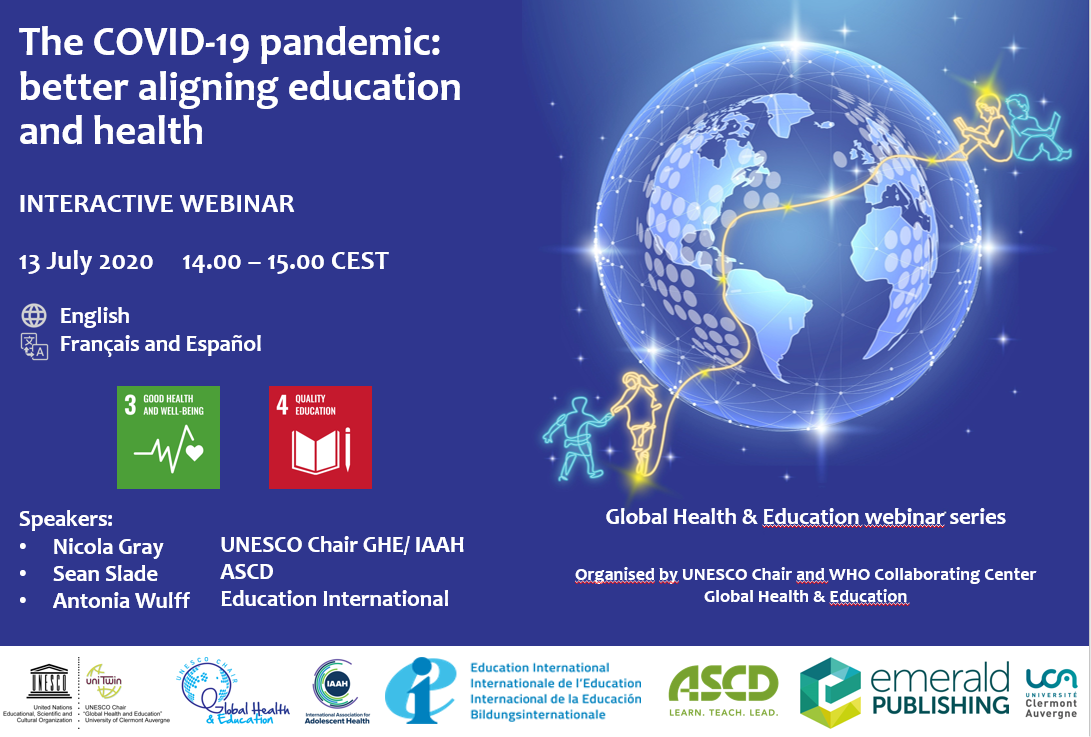
Webinar “Health Promotion Responses to the COVID-19 Pandemic” on 22 June 2020

Webinar “Health Promotion Responses to the COVID-19 Pandemic” on 22 June 2020

Join our interactive webinar “Health Promotion Responses to the COVID-19 Pandemic” on Monday, 22 June 2020 from 18:00 to 19.00 (CEST). This webinar will be an opportunity to discuss with Prof. Stephan Van den Broucke the way health promotion can respond to the COVID-19 pandemic and to ask him your questions during our live webinar.

The purpose of this webinar is to highlight the contribution of health promotion to the COVID-19 pandemic by answering the following three questions:

  • What can health promotion contribute in terms of management of the pandemic?
  • Fake news, understanding complex issues, health knowledge: how to develop the capacity of each individual to take charge of their own health?
  • There will probably be several waves of COVID-19 outbreaks or other pandemics. What are the health promotion recommendations for a sustainable response to the pandemic and for the future?

More information.

Link to join the webinar. 

The webinar will be accessible 15 minutes prior to the start of the session. No registration is required to participate in the webinar. 500 places will be available.
This webinar will also be broadcast live on our YouTube channel.

Posted by Didier in News
Stop tobacco industry exploitation of children and young people

Stop tobacco industry exploitation of children and young people

The World Health Organization is today launching a new kit for school students aged 13-17 to alert them to the tobacco industry tactics used to hook them to addictive products. Increasingly, the tobacco industry is targeting young people with nicotine and tobacco products in a bid to replace the 8 million people that its products kill every year.

This year’s WHO’s World No Tobacco Day campaign focuses on protecting children and young people from exploitation by the tobacco and related industry. The toolkit includes a set of classroom activities, an educational video, myth-buster quiz, and homework assignments.

Even during a global pandemic, the tobacco and nicotine industry persist by pushing products that limit people’s ability to fight coronavirus and recover from the disease.

“Educating youth is vital because nearly 9 out of 10 smokers start before age 18. We want to provide young people with the knowledge to speak out against tobacco industry manipulation,” said Ruediger Krech, Director for Health Promotion at WHO.

Over 40 million young people aged 13-15 have already started to use tobacco. To reach Generation Z, WHO launched a TikTok challenge #TobaccoExposed and welcomed social media partners like Pinterest, Tinder, YouTube and TikTok to amplify messaging.

https://www.youtube.com/watch?v=ByR0cONMSf8&feature=youtu.be

To find out more:

https://www.who.int/news-room/detail/29-05-2020-stop-tobacco-industry-exploitation-of-children-and-young-people

Posted by Didier in News
UNESCO launches a series of online forums entitled “Imagining the world to come”

UNESCO launches a series of online forums entitled “Imagining the world to come”

UNESCO is calling on inspiring voices from across the globe to take part in a series of online discussions to help us imagine the world taking shape as a result of the COVID-19 crisis. The series will kick off in May with a unique event featuring leading women experts and thinkers.

The COVID-19 crisis has had a major impact on societies, challenging what we thought were fundamental truths. Given that the pandemic is ongoing, and no one knows how it will end, it is all the more urgent that we take time to think. Indeed, these events have revealed the world in a new light, underlining the need for us to reflect on the future. That is what UNESCO, as a laboratory of ideas, intends to do. This week, UNESCO, is launching a series of online forums entitled “Imagining the world to come” to give voice to all those who will kick-start our reflections. The first forum features women, whose views have not been sufficiently heard during this crisis.

New contributions from women and men working in a wide range of disciplines around the world will be added to the platform in the coming weeks and months. These forums will inform UNESCO’s strategic reflections – making sure that tomorrow’s programmes meet the needs of our changing world. UNESCO also hopes that the series will inspire national policy-makers and make a positive contribution to global governance.

All contributions, however diverse, are welcome! Do not hesitate to support the promotion of this online forum by visiting the dedicated website and sharing it on your social networks.

In the face of Covid-19, UNESCO leads the reflection on

what the future should look like.

LINKS In English

Contact : forum@unesco.org

#UnescoForum #LeMondeAVenir #TheWorldToCome #ForumDeLUnesco #LaVoixDesFemmes #WomensVoices

Posted by Didier in News
Spotlight on adolescent health and well-being

Spotlight on adolescent health and well-being

The Health Behaviour in School-aged Children (HBSC), a WHO collaborative cross-national study, has been seeking to understand and monitor young people’s health across Europe and Canada for more than 30 years. As the study has grown to include 50 member countries and regions, the utility of the data it provides about the health, well-being, social environment and health behaviour of 11-, 13- and 15-year-old boys and girls has also grown. The seventh international report offers findings on adolescent health and well-being from 45 participating countries and regions in 2017/2018. It presents data from over 220 000 young people in 45 countries and regions in Europe and Canada. The data focus on social context (relations with family, peers, school and online communication), health outcomes (subjective health, mental health, overweight and obesity, and injuries), health behaviours (patterns of eating, physical activity and toothbrushing) and risk behaviours (use of tobacco, alcohol and cannabis, sexual behaviour, fighting and bullying) relevant to young people’s health and well-being. New items on electronic media communication and cyberbullying and a revised measure on family meals were introduced to the HBSC survey in 2017/2018 and measures of individual health complaints and underweight are also included for the first time in the report.

The report is divided into two volumes. Volume 1 provides an overview of the key findings highlighting important gender and socioeconomic differences, as well as changes since the last survey in 2013/2014. The key data are presented in Volume 2 in a series of charts showing country/region-level and overall prevalence by age, gender and family affluence.

Hans Henri P. Kluge, WHO Regional Director for Europe, explains the following in his foreword: “Life has changed enormously in Europe over the last two decades. Digitization, globalization, migration, urbanization and climate change mean we now live in a more complex Europe. Young people are often the first to be exposed to and affected by these changes and have become outspoken advocates on issues such as climate change. It is important, at European level and in each country/region, to understand what young people think, know and understand in terms of their health, and how they behave. The Health Behaviour in School-aged Children (HBSC) study, now presenting its seventh international report, helps us with all of this. HBSC is truly international; (…) And its primary purpose is to advocate for policy changes to safeguard the health and well-being of one of society’s most vulnerable groups – children and adolescents. (…) . This seventh international report and the vital data it presents shows that HBSC is, and will continue to be, a central support of the new vision for the WHO Regional Office for Europe.

Posted by Didier in News
Questionnaire reopening schools and COVID-19

Questionnaire reopening schools and COVID-19

With the reopening of schools in countries where they have been closed, we are now entering a new phase of the COVID-19 pandemic. These nationwide and localized closures of schools are impacting over 90% of the world’s student population (around 1.3 billion children and young people). Reopening schools is not an easy thing to do, although at this stage of the pandemic in most countries it is a priority because the impact of closure is massive. The concrete mechanisms of the reopening differ, depending on the socioeconomical context and the cultures of the countries.

Since this pandemic is unique so as the extend of closure, there is a crucial need for sharing information about the local and national strategies in different contexts. That’s why the UNESCO Chairs and WHO Collaborating Centre on Global Health and Education together with the Schools for Health in Europe network foundation (SHE) and the EUPHA Health Promotion Section have launched a knowledge sharing process on school reopening.

We would be happy if you are prepared to complete the short questionnaire about the situation in your country, region, city or school in order to enrich the inventory of practices. Your contribution will be added to our webpage about COVID-19 where you find the articles related to the available scientific data, guidelines developed by UNESCO, WHO, WASH in Schools and other institutions and the practices collected worldwide by the community of the Chair.

Thank you in advance for your contribution.

Posted by Didier in News
Bringing a Health Promotion perspective to COVID-19 response by EUPHA-HP, IUHPE and UNESCO Chair

Bringing a Health Promotion perspective to COVID-19 response by EUPHA-HP, IUHPE and UNESCO Chair

A Health Promotion Focus on COVID-19. Keep the Trojan horse out of our health systems: Promote health for ALL in times of crisis and beyond!”.

Ongoing discussion about the range of actions needed during the SARS-CoV-2 outbreak and Coronavirus Disease 2019 (COVID-19) is calling all of us to bring forward our thoughts and experiences about how best to cope with the multiple challenges we are facing regarding COVID-19. The Health Promotion section of the European Public Health Association, IUHPE and the UNESCO Chair Global Health & Education would like to share five talking points that could evolve into a more refined and targeted public health discussion on the implications of this pandemic, from a health promotion perspective.

As discussions worldwide bring topics such as health, equity, sustainability, solidarity or human dignity to a new level of implications, a systematic perspective is missing to bring these themes together with the disease prevention and curative efforts in the public health framework. This is where health promotion has the expertise to bring these extremely relevant issues together, to offer a comprehensive approach, in a common effort to support the medical care systems to face the sudden burden that was laid in their hands.

Authors: Luis Saboga-Nunes, Diane Levin-Zamir, Uwe Bittlingmayer, Paolo Contu, Paulo Pinheiro, Valerie Ivassenko, Orkan Okan, Liane Comeau, Margaret Barry, Stephan Van den Broucke, Didier Jourdan

Click here to download the document

Posted by Didier in News
A framework to guide an education response to the COVID-19 Pandemic of 2020

A framework to guide an education response to the COVID-19 Pandemic of 2020

OECD recently published a report which aims at supporting education decision making to develop and implement effective education responses to the COVID-19 pandemic. In most countries around the world school-based education will be disrupted for several months due to the social isolation measures as a response to the COVID-19 Pandemic. Without an effective strategy to protect learning opportunities during this period, this disruption will cause severe learning losses for students.

It is therefore highly important that education leaders take immediate steps to develop and implement strategies which reduce the educational impact of the pandemic. The report proposes that leaders of education systems and organizations develop plans for the continuation of education through alternative methods.

The report offers a framework to guide the development of context-specific education strategies. It includes a checklist of 25 points to support the development of an education strategy during the pandemic. This can be used by national, state or local education authorities or by leaders of education networks.

Based on a rapid assessment of education needs and emerging responses in ninety eight countries, the report identifies the most critical needs that should be addressed in these plans, as well as the areas likely to face more implementation challenges. The domains identified as highest priority are: ensuring academic learning for students, supporting students who lack skills for independent study, ensuring the wellbeing of students, providing professional support for teachers and ensuring wellbeing of teachers and medical attention to teachers. The identified priorities are closely related to the UNESCO Chair’s ambitions. The report describes the challenges facing various education systems to depend on online education as an alternative of school-based education.

Read the report.

Posted by Didier in News