Didier

Participate in the second survey on the safe reopening of schools

Participate in the second survey on the safe reopening of schools

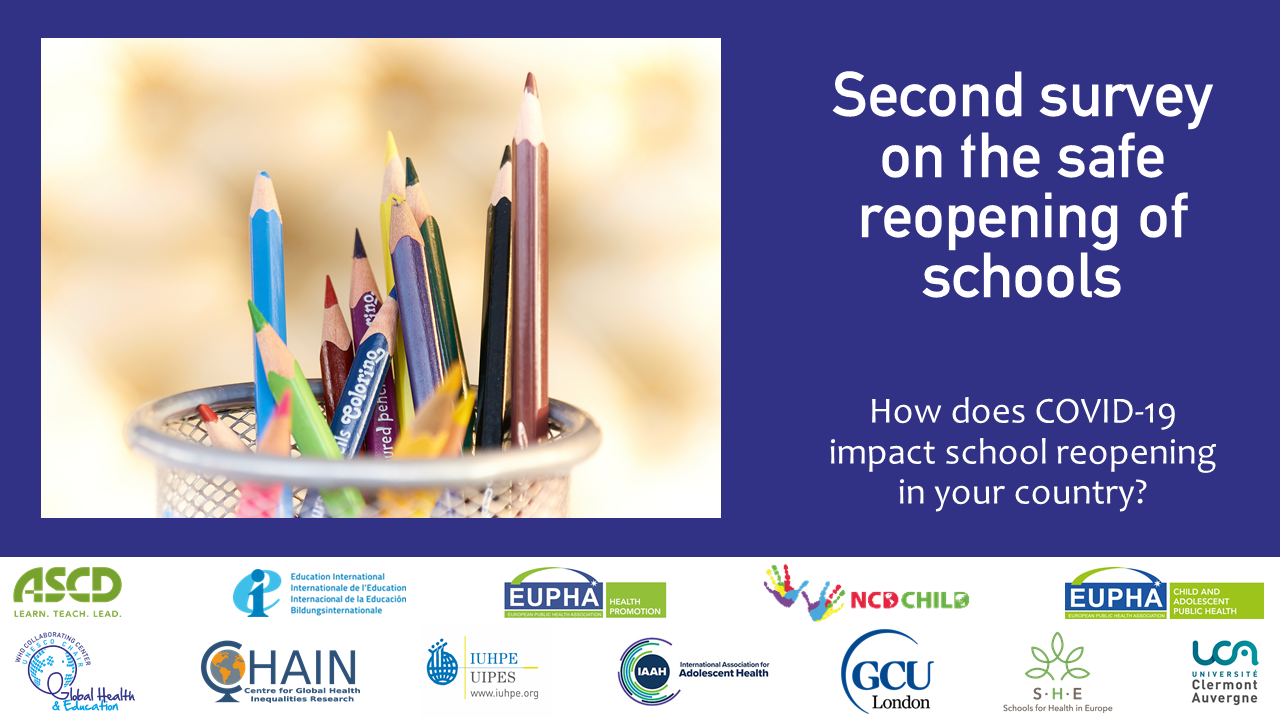
You are invited to complete the second survey on the safe reopening of schools and to share the survey within your network. The aim of the survey is to gather the experiences and opinions of education and health professionals about the processes in place in their countries and territories to reopen schools safely during the COVID-19 pandemic, and to keep them open.

We want to continue to form a bridge between the scientific data and the needs of people who are implementing national guidance and feeling the impact of the ongoing pandemic in schools and the surrounding communities. It will reflect on intersectoral working to date, and recommendations for moving forward.

The survey explores the public health measures that have been put in place in schools; communication of guidance at national and/or local level, and the facilitators or barriers to safe reopening. The survey should take 10-20 minutes to complete. It is a follow-up of the survey which was conducted in May/June 2020.

The survey is conducted by the UNESCO Chair and WHO Collaborating Center in Global Health & Education with the support of its consortium partners from ASCD, CHAIN, Education InternationalEUPHA Child and Adolescent Public Health, EUPHA Health PromotionGCU London, IAAH and their Young Professionals’ Network, IUHPE, NCD Child, UCA and the SHE Network.

More information and access to the survey link

Posted by Didier in News
The Lancet Child & Adolescent Health – Podcast

The Lancet Child & Adolescent Health – Podcast

In Conversation With… Didier Jourdan & Nicola Gray

Didier Jourdan & Nicola Gray join The Lancet Child & Adolescent Health Editor-in-chief Jane Godsland to discuss how and why child health professionals should be supporting schools to become the foundation of a healthy life.

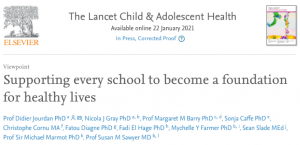
Didier Jourdan & Nicola Gray are the lead authors of the viewpoint “Supporting every school to become a foundation for healthy lives” which was published in the Lancet on Friday 22 January 2021

Listen to the podcast

Read the viewpoint article

Posted by Didier in News
Supporting every school to become a foundation for healthy lives

Supporting every school to become a foundation for healthy lives

Article published in the Lancet on Friday 22 January 2021

This recent article[1] in the Lancet Child & Adolescent Health is both an advocacy tool and a roadmap for building bridges between education and health and enabling the development of intersectoral practices in schools.

Child and adolescent health is influenced by a complex set of cultural, environmental, social and economic factors. Schools, as an educational setting where children spend a large part of their daily lives, have an important influence on the health and wellbeing of students. The discussions about reopening schools during the COVID-19 pandemic have shown the interconnectedness of health and education inequalities.

The article takes stock of the available evidence on school health interventions and the conditions necessary for their effectiveness and sustainability. It calls for an educational look at health issues. It reminds us that to improve health and reduce inequalities, all pupils must attend school from an early age and for as long as possible, and that their success at school must be maximised. Coherence between policies, structures and systems, human resources and practices in each school is necessary to improve school and health outcomes. Finally, it shows that health professionals can be catalysts for structural change and act as vehicles for cross-sectoral implementation of reforms and innovations in school systems to promote the health of all students.

Read the article and the editorial of the Lancet

[1] Jourdan, D., Gray, N. J., Barry, M. M., Caffe, S., Cornu, C., Diagne, F., El Hage, F., Farmer, M. Y., Slade, S., Marmot, M., & Sawyer, S. M. (2021). Supporting every school to become a foundation for healthy lives. The Lancet Child & Adolescent Health. https://doi.org/10.1016/S2352-4642(20)30316-3

Posted by Didier in News
Recording of regional workshop ‘School Health in Latin America: Intersectoral NCD Prevention and Management’

Recording of regional workshop ‘School Health in Latin America: Intersectoral NCD Prevention and Management’

On December 14 and 15, 2020, NCD Child, in partnership with the Healthy Latin America Coalition (CLAS) and the American Heart Association, hosted a two-day regional workshop entitled ‘School Health in Latin America: Intersectoral NCD Prevention and Management’ that focused on strengthening partnerships across the health and education sectors and promoting a whole-school approach in preventing and managing non-communicable diseases (NCDs) in the region, with a special focus on adopting school health strategies during the COVID-19 pandemic.

Professor Didier Jourdan, holder of the UNESCO Chair and head of the WHO Collaborating Center in Global Health & Education, participated as a keynote speaker on day two of the workshop which focused on strategies for educational continuity and management of NCDs during the COVID-19 pandemic. You can see his presentation on the UNESCO Chair website.

Visit NCD Child’s YouTube channel to watch the full presentations for both days, available in English, Spanish and Portuguese.

Posted by Didier in News
Webinar: Health literacy in schools: an education asset in the 21st century

Webinar: Health literacy in schools: an education asset in the 21st century

On 21 January 2021 from 14.00 – 15.00 CET, the interactive webinar “Health literacy in schools: an education asset in the 21st century” will take place. The webinar is part of the Global Health & Education webinar series and organised by the UNESCO Chair Global Health & Education in collaboration with Schools for Health in Europe Network Foundation (SHE). The webinar will be held in English.

The aim of this webinar is to discuss health literacy in the school context and the educational sector. Health literacy is a critical 21st century competence that enables children and adolescents to critically evaluate health information, make informed decisions about health, and inform their health behaviour. The development of health literacy begins as early as in childhood and schools represent the most promising setting to facilitate the enhancement of child and adolescent health literacy.

During this webinar the experts: Associated Professor Leena Paakkari, University of Jyväskylä, Faculty of Sport and Health Sciences, Finland, Doctor Orkan Okan, Bielefeld University, Faculty of Educational Science, Interdisciplinary Centre for Health Literacy Research, Germany, and Professor doctor Kevin Dadaczynski, Fulda University of Applied Science, Fulda Public Health Centre, Leuphana University Lueneburg, Germany, will address the following questions:

  1. What is health literacy and why do we need to address it in schools?
  2. Why should we incorporate health literacy into the school curriculum?
  3. How can we embed health literacy into school health promotion frameworks?

Link for the webinar: https://us02web.zoom.us/j/83136909908

More information

Posted by Didier in News
School Health in Latin America: Intersectoral NCD Prevention and Management

School Health in Latin America: Intersectoral NCD Prevention and Management

On the 14th and 15th of December NCD Child, in partnership with the Healthy Latin America Coalition (CLAS) and the American Heart Association organize two days of dialogue around the theme: School Health in Latin America: Intersectoral NCD Prevention and ManagementThe webinar will be held in English.

The online meeting will focus on strengthening partnerships in the health and education sectors and promoting a school-wide approach to preventing and managing noncommunicable diseases (NCDs) in the region. There will also be a particular focus on the adoption of school health strategies during the COVID-19 pandemic.

On the 14th of December from 11:00 AM – 12:40 PM EST, Dr. Sonja Caffe -Regional Adolescent Health Advisor, Pan American Health Organization will present: Advocating for the prevention of NCDs through a whole-school approach.

On the 15th of December from 11:00 AM – 12:40 PM EST, Pr. Didier Jourdan, Chairholder of the UNESCO Chair Global Health & Education in France will introduce: Education and health in schools during the pandemic: what have we learned from the field about the successes and challenges?

To register 

Posted by Didier in News
Soft launch: ‘Using the revised International Technical Guidance on Sexuality Education to steer CSE policy and programmes’

Soft launch: ‘Using the revised International Technical Guidance on Sexuality Education to steer CSE policy and programmes’

On Wednesday 9 December 2020 at 9.00 am New York time and 3.00 pm Paris time UNESCO and UNFPA will organise the soft launch of the Global Partnership Forum on Comprehensive Sexuality Education. The dialogue will be held in English.

The webinar will be opened by Vibeke Jensen, UNESCO and Benoit Kalasa, UNFPA. Patricia Machawira, UNESCO East and Southern Africa Regional Office, Maria Bakaroudis, UNFPA East and Southern Africa Regional Office, Maki Akiyama, UNFPA Asia-Pacific Regional Office, Jessie Freeman, Plan International and Jona Turalde, IPPF youth advocate, Philippines will be part of the panel. This soft launch will be the first in a series of online dialogues to launch and establish the Forum and enable participants to interact.

The first dialogue will deepen how the revised International Technical Guidance on Sexuality Education, and the principles contained therein, have been applied as well as some good practices. It is also an opportunity for participants to exchange views on the expectations and the development of the Forum as a community of practice.

For registration click here

Posted by Didier in News
Interactive WEBINAR: Education as a “social vaccine” against COVID-19

Interactive WEBINAR: Education as a “social vaccine” against COVID-19

On 10 December 2020 from 14.00-15.00 CET, the interactive webinar: Education as a “social vaccine” against COVID-19 will take place. The webinar is part of the Global Health & Education webinar series and organised by the UNESCO Chair Global Health & Education in collaboration with CHAIN (Centre for Global Health Inequalities Research), EuroHealthNet and Newcastle University. The webinar will be held in English.

Historically, pandemics have been experienced unequally with higher rates of infection and mortality among lower educated people, particularly in more socially unequal countries. Emerging evidence suggests that these inequalities are being mirrored today in the COVID-19 pandemic. Both then and now, these inequalities have emerged through the syndemic nature of COVID-19 — as it interacts with and exacerbates existing social inequalities in chronic disease and the social determinants of health.

During this webinar the experts: Professor Terje Andreas Eikemo, Professor of Sociology, Centre for Global Health Inequalities Research (CHAIN), Dept of Sociology and Political Science, Norwegian University of Science and Technology, Norway, Professor Clare Bambra, Professor of Public Health, Population Health Sciences Institute, Faculty of Medical Sciences, Newcastle University, United Kingdom and Caroline Costongs, Director of EuroHealthNet, Belgium will address the following questions :

  1. What are the inequalities rising from the pandemic and how is COVID-19 being experienced as a syndemic pandemic?
  2. How can we best protect our populations against the negative social, economic and health-related consequences of the current and future pandemics?
  3. What are the consequences for public health, economic and social policies?

To participate: Zoom link.

This webinar will also be broadcast live on our YouTube channel.

More information.


Posted by Didier in News
Webinar: Health, literacy and education in Persian speaking countries

Webinar: Health, literacy and education in Persian speaking countries

On 3 December 2020, 8.30-10.00 CET, 11.00-12.30 Iran, 12.00-13.30 AFT, 12.30-14.00 TJT the webinar “Health, literacy and education in Persian speaking countries: achievements, challenges and the link” will take place. It is the first webinar in Persian in the Global Health & Education webinar series.

Do we really acknowledge the health-education co-evolution in health promotion research, policy and practice?

Speakers from Iran, Afghanistan and Tajikistan will present a brief explanation of the importance of knowledge exchange and production within networks of different languages for the UNESCO Chair Global Health & Education. As well as the value of exchange of knowledge and experience among neighbouring countries. Furthermore, the speakers will share with the audience the current state of health and education in the 3 Persian speaking countries, the challenges and achievements and their perspectives about the way forward to achieve the joint goals of “health for all” and “education for all” through the “education for health and health for education” strategy.

The webinar will opened by:

  • Alireza Zali, Vice-chancellor of Shahid Beheshti University of Medical Sciences, Iran
  • Mojtaba Zeinivand, Deputy Minister of Education, Iran
  • Didier Jourdan, UNESCO Chair Global Health & Education, France

Speakers are:

  • Nastaran Keshavarz Mohammadi, School of Public Health, Shahid Beheshti University of Medical Sciences, Iran, Co-chair of the Scientific and Ethical committee, UNESCO Chair Global Health & Education
  • Abdul Jalal, M.A International Public Policy, M.A International Relations, External-Policy and Partnership Consultant, Aga Khan Cultural Services-Afghanistan
  • Nazira Sodatsayrova, Secondary School Teacher Educator, Tajikistan

They will address the following questions:

  1. What is the current status of health and education in the 3 countries?
  2. What is the local evidence for the link between health and education?
  3. What are the challenges in acknowledging the health-education co-evolution in health promotion research, policy and practice?

To participate: Zoom link

This webinar will also be broadcasted live on our YouTube channel

More information: bit.ly/webinar3DEC

Posted by Didier in News
Video Webinar: School issues in children during COVID-19

Video Webinar: School issues in children during COVID-19

Watch the video of the Webinar on School issues in children during COVID-19 organized by the International Pediatric Association (IPA), UNICEF and WHO.

On 2 November, IPA, UNICEF and WHO organised a webinar in French on “School issues in children during COVID-19”. The invited experts spoke about the difficulties of the child in school during the COVID-19 pandemic. They highlighted the significant impact on schoolchildren in terms of learning, loss of opportunities but also the consequences on dropping out of school. This webinar wished to return to the issues in order to better guide professionals towards a successful return to school by following the recommendations.

Pr. Rachida Boukari from the University of Alger, host and moderator of this webinar, was surrounded by experts:

  • Didier Jourdan, holder of the UNESCO Chair Global Health & Education presented “Data from a study of professionals from 42 countries on the process of reopening schools”
  • Mbola Mbassi, Doctor and public health expert at national and international level spoke of the “WHO School Health Services Guidelines for COVID-19”
  • Joseph Haddad, Professor of Pediatrics and Neonatology at Saint George Beirut University Hospital, Lebanon raised “The challenges of Education and Disability in children and COVID-19”.

Pr. Didier Jourdan recalled the interest of this survey which was to collect the points of view of professionals in the field, testimonies from the field on the possible reopening of schools in different countries, and on the successes and difficulties encountered in reopening schools.

In his review of the “WHO School Health Services Guidelines for COVID-19” Dr. Symplice Mbola Mbassi mentioned that schools have been closed in over 190 countries, reaching 90% of the global student population. He added that school closures have exposed children to more anxiety, depression, violence, physical inactivity, poor diet, loss of learning, sedentary lifestyle and increased screen time but also for parents an increase in unmet childcare needs. Dr. Symplice Mbola Mbassi pointed out that schools are places of protection, of learning opportunities. They provide social protection, nutrition, physical activity but also emotional support.

Finally, Pr. Joseph Haddad talked about “The challenges of education and disability in children and COVID-19”. He emphasized the importance of a comprehensive approach to the care of children with disabilities that ensures dignity, based on the rights and needs of these children. The rights of these children are the same as to others, such as the right to education, medical care, rehabilitation, social support and social integration.

Watch the video: https://www.youtube.com/watch?v=JJHqv-vlia0

Posted by Didier in News