The UNESCO Chair and WHO Collaborating Center on Global Health and Education invites all those interested in promoting health and equity at a community level to the first edition of the Global Community Health Annual Workshop that will take place on 6, 7 and 8 July 2021.
The main aim of the workshop is to explore the diverse practices of community health worldwide, learn from them, and apply those newly acquired skills and knowledge to current/future projects.
We welcome all those involved in health promotion, prevention, healthcare and social care services.
This year’s course will be online and FREE of charge. Participants and tutors will learn from the diversity in community health practices.
As the world enters a second year living with the COVID-19 pandemic, half of the global student population is still affected by full or partial school closures. To mobilize and support learning continuity, UNESCO established the Global Education Coalition which today counts 160 members working around three central themes: Gender, connectivity and teachers.
On 29 March 2021, UNESCO convened a high-level ministerial meeting “One year into COVID: Prioritizing education recovery to avoid a generational catastrophe” to take stock of lessons learnt, the greatest risks facing education today and strategies to leave no learner behind. During this meeting, Professor Didier Jourdan, chair holder of the UNESCO Chair and head of the WHO Collaborating Center Global Health and Education, was invited to present a state-of-the-art review of the evidence about keeping schools open safely.
Professor Jourdan presented three solid facts:
schools should be among the last places to close and first to reopen
school reopening, with comprehensive infection prevention and control measures in place, and when the community infection levels were low or moderate, did not increase community transmission
the mechanisms of implementation in schools involve institutional, contextual and personal factors
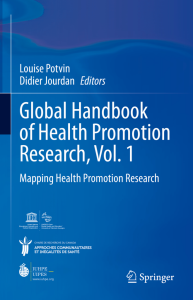
This call is intended to identify experiences that produce a dialogue between teaching and learning practices carried out locally and the possibilities of application and transformation from local to global reality. The book is to be published by Springer Publisher and launched at the 24th IUHPE World Conference on Health Promotion, in Montreal, Canada, 2022.
The book is about teaching and learning health promotion in the health professions undergraduate and postgraduate courses, bearing in mind the Health Promotion approaches, according to WHO and the five strategies of Ottawa Chapter. In addition, chapters on how health promotion is taught in related fields such as architecture, urban planning, and social protection, as well as various areas of public policy and international affairs etc. are welcome.
In this recently published French article “Élaboration et évaluation de l’utilité, de l’utilisabilité et de l’acceptabilité de ressources éducatives produites en réponse à la crise de la COVID-19[i]” (in English: ‘Development and evaluation of the usefulness, usability and acceptability of educational resources produced in response to the COVID-19 crisis’) the authors reflect on the development and evaluation of the “Succeed, be well, be together” health promotion programme in New Caledonia in response to the COVID-19 pandemic. The programme uses a co-construction approach to health education teaching materials that takes into account cultural diversity, builds on existing practices, shares them and enriches them with research contributions. It was implemented in order to develop with the actors, in a very short time, a set of tools for primary schools in order to ensure pedagogical continuity during the COVID-19 crisis. The evaluation of these tools with professionals in practice and in training (n = 50) shows that they are usable in reference to existing classroom practices (score of 8.2 out of 10) and to the needs of pupils (score of 8 out of 10), useful for the development of skills and knowledge in health education (score of 8.4 out of 10), and acceptable in relation to pedagogical approaches, contextualised materials and their implementation (score of 8.3 out of 10). The study shows that health promotion as an approach can provide a framework for the development of appropriate intervention tools in times of health crises.
[i] Tessier N, O’Callaghan N, Fernandez Da Rocha Puleoto C, Jourdan D. Élaboration et évaluation de l’utilité, de l’utilisabilité et de l’acceptabilité de ressources éducatives produites en réponse à la crise de la COVID-19. Global Health Promotion. March 2021. doi:10.1177/1757975921996133
Our world is home to the largest generation of adolescents ever. Our future global success and prosperity depends on their sustained health and wellbeing. And yet the amount of investment in adolescent health is traditionally very low. This forms the backdrop to a range of health inequalities, and yet the adolescent population has arguably had the least attention of all age groups on this topic. For many disadvantaged, deprived and discriminated youth, health system accessibility and utilization are substantially and unacceptably lower compared to the general population. To increase health system accessibility and utilization in underserved communities, barriers must be removed. In this webinar, examples of underserved communities are presented, as well as possible solutions to make global health systems available, acceptable and affordable for every adolescent.
The webinar will start with an introduction from Professor Sir Michael Marmot, Professor of Epidemiology, University College London; Director of the UCL Institute of Health Equity. The experts Professor Susan Sawyer, president International Association for Adolescent Health, The University of Melbourne, Australia and Associated professor Danielle Jansen, immediate past president EUPHA Section on Child and Adolescent Public Health, University Medical Center Groningen (UMCG), the Netherlands, will then address the following questions:
What do we know about global inequalities in adolescent health outcomes?
Which health service barriers linked to health inequalities do adolescents experience in Europe?
How can we use this knowledge to redesign healthcare systems to minimise adolescent health inequalities?
International Adolescent Health Week, celebrated the 3rd full week in March yearly, is a grass-roots initiative for young people, their health care providers, their teachers, their parents, their advocates and their communities to come together and celebrate young people and with an ultimate goal of working collectively towards improving the health and well-being of the over 1 billion adolescents across the globe today.
The Mission of International Adolescent Health Week is to inspire adolescents and their communities to advocate for a successful transition into adulthood. It is based on the idea that small actions by many people working together create big changes.
Lime green is the official colour of International Adolescent Health Week.
Monday 29 March, 14:00 CET, a high-level Ministerial on-line event
As the world enters a second year living with the COVID-19 pandemic, UNESCO will convene a high-level ministerial event on 29 March to take stock of lessons learnt, the greatest risks facing education and strategies to leave no learner behind, building on the actions of the Global Education Coalition (GEC) established in March 2020 that marks its first anniversary.
The meeting will provide the global education community with a space for policy dialogue to assess lessons learnt and the most pressing current challenges, informed by the presentation of key data sets. Main participants will be Ministers of Education, high-level representatives of partners within the GEC and of sister agencies. The debate will be framed around three key topics related to:
School dropout & learning loss: what are the top policy measures taken to mitigate against school drop out? What remedial actions have been most successful so far to make up for learning loss?
Keeping schools open, prioritizing and supporting teachers: how to keep schools open as a priority and ensure a safe learning environment? How to ensure that teachers are safe, considered as frontline workers and supported to adapt to a new learning reality?
Digital transformation and the future of education: what are the key strategies for digital transformation of education systems? How can public-private partnership contribute to advancing the digital transformation? How has COVID-19 impacted the future of education?
Professor Didier Jourdan, chair holder of the UNESCO Chair Global Health & Education will deliver an opening presentation about emerging evidence on safe school reopening.
EuroHealthNet launched a new online portal for information and resources on health inequalities in Europe, health-inequalities.eu. It is a platform for international exchange including information, policies, research, and initiatives on health inequalities, for anyone who has a role in the COVID-19 recovery and building a more sustainable and fair future.
This portal is for public health professionals to exchange ideas and experiences, and for civil servants, educators, and people working on environment, social, and employment issues to find resources to help address inequalities in their fields.
You are invited to complete the second survey on the safe reopening of schools and to share the survey within your network. The aim of the survey is to gather the experiences and opinions of education and health professionals about the processes in place in their countries and territories to reopen schools safely during the COVID-19 pandemic, and to keep them open.
We want to continue to form a bridge between the scientific data and the needs of people who are implementing national guidance and feeling the impact of the ongoing pandemic in schools and the surrounding communities. It will reflect on intersectoral working to date, and recommendations for moving forward.
The survey explores the public health measures that have been put in place in schools; communication of guidance at national and/or local level, and the facilitators or barriers to safe reopening. The survey should take 10-20 minutes to complete. It is a follow-up of the survey which was conducted in May/June 2020.
There has been a lot of talk about priorities, and even priorities of priorities. In terms of priorities, I know of only two: public education and public health.