Webinar

Combating gender-based violence in schools: international webinar and launch of a new training programme

Combating gender-based violence in schools: international webinar and launch of a new training programme

School-Related Gender-Based Violence (SRGBV) affects millions of students around the world every year. It not only compromises the safety and well-being of children and adolescents, but also hinders their access to inclusive and equitable education.

In this context, UNESCO, the United Nations Girls’ Education Initiative (UNGEI) and UNICEF are organising an international webinar on 18 March 2026 dedicated to preventing and responding to gender-based violence in schools. This event will also mark the global launch of a new online training module on SRGBV, accessible via UNICEF’s AGORA learning platform.

The webinar will bring together government representatives from South Africa, Jamaica and Laos, as well as young leaders, teachers and civil society organisations involved in preventing violence in and around schools. Discussions will highlight concrete solutions for strengthening educational policies, teaching practices and mechanisms for protecting students.

The new online course offers a set of evidence-based resources, including practical tools, feedback and contributions from adolescents, feminist activists, institutional actors and public officials. The aim is to support education systems in developing effective strategies for preventing and addressing gender-based violence.

This webinar is an opportunity to share international experiences and identify levers for action to create safer, more inclusive and gender-equitable school environments.

Practical information

Date: 18 March 2026
Time: 3:00 p.m. – 4:15 p.m. (Paris time)
Simultaneous interpretation: English, French, Spanish and Hindi
Registrationregistration link

Posted by Didier in News
Planning for healthy and thriving learners: Global launch – 20 November 2025

Planning for healthy and thriving learners: Global launch – 20 November 2025

UNESCO is launching Planning for healthy and thriving learners – a coordinated programme of work to embed health and well-being into education sector planning.

Planning for healthy and thriving learners aims to translate high-level commitments into concrete action, placing learners’ health and well-being at the centre of education systems. It provides practical tools, builds capacity, and empowers education authorities to take the driving seat in mobilizing support and resources from other sectors.

Planning for healthy and thriving learners builds on UNESCO’s Strategy on Education for Health and Well-being and  the Making Every School a Health-Promoting School  initiative, and is advanced in collaboration with  the  Inter-Agency Group on School Health and Nutrition. 

The Chair is one of the contributors to the strategic resources for planning and policy-making. The briefing note, a high-level advocacy tool for decision-makers, and the Handbook on integrating health and well-being into education sector planning, which provides step-by-step guidance for ministries of education and partners across the sector planning cycle, from analysis and policy formulation to implementation and monitoring.

The launch welcomes education stakeholders, planners and partners. It is organized by UNESCO, including its Headquarters, International Institute for Capacity Building in Africa (IICBA), and Regional offices in Dakar and Harare, in partnership with the African Union (AU) and the Inter-Agency Group on School Health and Nutrition. You can register for the global webinar (hybrid) – connecting Addis Ababa with participants worldwide to showcase tools and country experiences, on 20 November 2025, afternoon.  Interpretation will be available in English, French and Portuguese for all sessions, with Spanish added for the webinar.

Posted by Didier in News
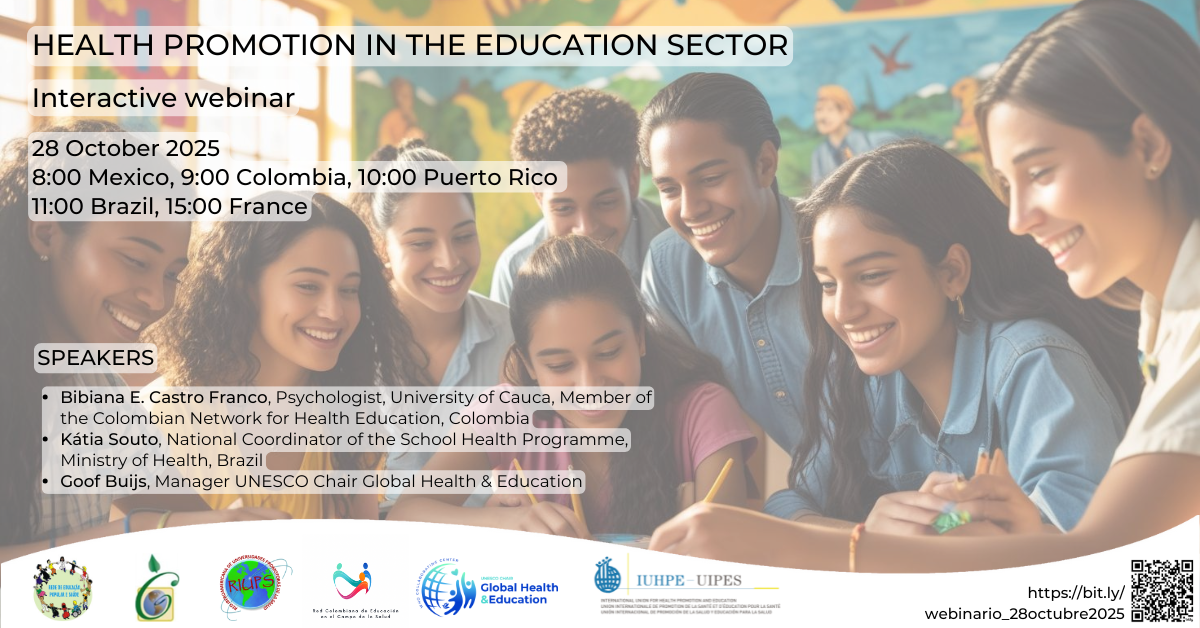
Webinar 28 October 2025 – Health promotion in the education sector

Webinar 28 October 2025 – Health promotion in the education sector

Time: 8.00 – 9.30 Mexico, 9.00 – 10.30 Colombia, 10.00 – 11.30 Puerto Rico, 11.00 – 12.30 Brazil, 15.00 – 16.30 France

Language: The webinar will be held in Spanish and Portuguese. Translation will be available in 50+ languages, including English, French, Portuguese and Spanish. We will use a translation app based on AI.

RegistrationRegister here. Registration is free. The link to the webinar will be sent to you after registration.

Información en español, Informações em português


Speakers

Moderator

Prof. Dr. Fernando Peñaranda Correa. He is a doctor, holds a master’s degree in public health, a master’s degree in education and social development, and a doctorate in social sciences, childhood and youth. He is a full professor and senior researcher in the Health and Society Research Group at the National School of Public Health at the University of Antioquia. He is the coordinator of the health education emphasis in the Master’s in Public Health programme. He has taught undergraduate and postgraduate programmes at the Faculty and other universities in the country on the following topics: epistemology, qualitative research, ethics and social justice, public health, health promotion, and health education. He has written numerous articles, book chapters, and books in the areas of health education, qualitative research, ethics, public health, and social justice.

Bibiana E. Castro Franco. Psychologist, specialising in social psychology, Master’s degree in Public Health and Doctorate in Human Sciences. Lecturer at the University of Cauca. Department of Education and Pedagogy. Researcher with the Popular and Community Education Group. Member of the Colombian Network for Health Education. CLACSO Working Group on International Health and Health Sovereignty.

Kátia Souto, National Coordinator of the School Health Programme, Ministry of Health, Brazil

Goof Buijs. Manager of the UNESCO Chair Global Health & Education. After finishing his Master study in Human Nutrition his first job was teaching health science at the Amsterdam teacher trainer institute. Next he moved into the field of health promotion, as health promotion officer in Amsterdam. At the Netherlands Institute for Health Promotion NIGZ he specialized in school health promotion, first on the Dutch level to introduce the national health promoting school programme and leading several European projects. In 2007 he became the manager of the Schools for Health (SHE) network until 2017. In 2018, with prof Didier Jourdan, he set up the UNESCO Chair Global Health & Education, also the WHO Collaborating Centre. His specialisation is bringing health and education sectors together. He is an experienced networker, expert in co-creation, trainer, and organizer of local and global events. He supports cooperation among people, focusing on everyone’s talents and uniqueness. He is an environmental activist for most of his life.


Summary

During this webinar the speakers will analyse experiences with health promotion in the education sector in various countries to identify achievements, challenges and opportunities. Each speaker will share their respective experiences, identifying the progress, strengths, difficulties and challenges involved in coordinating the education and health sectors to promote health promotion and health education in schools. This will be followed by time for attendees to ask questions and make comments on the presentations given by the speakers.


Latin American Network for the Revitalisation of Health Education

This webinar is a part of the “Latin American Network for the Revitalisation of Health Education”. This initiative is being promoted with the participation of the UNESCO Chair on Global Health and Education, the Inter-American Consortium of Universities and Training Centers for Health Education and Health Promotion (CIUEPS), the Brazilian Network of Popular Health Education, the Colombian Network of Health Education and the Regional Office for Latin America of the International Union of Health Promotion and Education (IUHPE/ORLA), with the following objectives:

  • Promote health education at national and international levels, as a fundamental dimension of the health disciplines, the educational sciences and the social and human sciences.
  • To recuperate the Latin American production and position it in the regional level, which implies promoting its critical and decolonial approaches. A health education that advocates for social transformation towards a more just and equitable society that guarantees well-being and a life with dignity.
  • Promote the articulation of the education and health sectors to strengthen the actions of each of these sectors to promote health education, by recognizing education and health as two inalienable, synergistic and interdependent human rights.
  • Strengthen the theoretical, political and ethical foundations of health education as a requirement for a responsible, productive and ethical pedagogical practice.
  • To generate a setting for the articulation of academia and civil society that allows Latin American integration in order to share experiences, knowledge and aspirations framed in a collective purpose.
  • To promote national and international integration with respect to health education as a means for mutual learning and solidarity, and to facilitate cooperative actions in the development of academic-scientific events, research and training processes.

The webinars, open to all interested stakeholders, are a component of the program. They are experiential sessions, lasting 60-90 minutes, with guest speakers who present their reflections on two or three problematic questions to encourage audience participation. Five webinars have been scheduled for this first stage of the program, with an interval of 2 months between each one.

Watch the recordings of previous webinars:

Posted by Didier in News
25-26 September 2025: Launch of the ‘Social inequalities in health in Europe’ report

25-26 September 2025: Launch of the ‘Social inequalities in health in Europe’ report

Source: EuroHealthNet

On Thursday 25 September and Friday 26 September, EuroHealthNet will launch its landmark report, Social Inequalities in Health in the EU. The report has been developed in collaboration with the Centre for Health Equity Analytics (CHAIN).

This trend study, based on data from the European Social Survey in 2014 and 2024, provides the most detailed picture to date of social inequalities in health across Europe over the past ten years. It shows health and mental health outcomes across groups with different levels of education and occupation, and how these outcomes have changed over the past 10 years. The report also presents examples of promising actions from across Europe and provides recommendations for EU and national policymakers.

The findings are a call to action. Rising living costs, climate change, employment insecurity, and environmental degradation are widening social inequalities in health and undermining physical and mental wellbeing. 

Addressing these determinants of health is essential for protecting Europe’s social model, ensuring health as a human right, as well as fostering healthier, more resilient, and more productive societies.

The report will be launched in two parts: a live-streamed, high-level debate in the European Parliament on 25 September from 13.00 – 15.00 CEST and a webinar on country-level data and measures on 26 September from 10.00 – 12.30 CEST.

Agenda and registration for the high-level debate in the European Parliament

Agenda and registration for the launch webinar

Posted by Didier in News
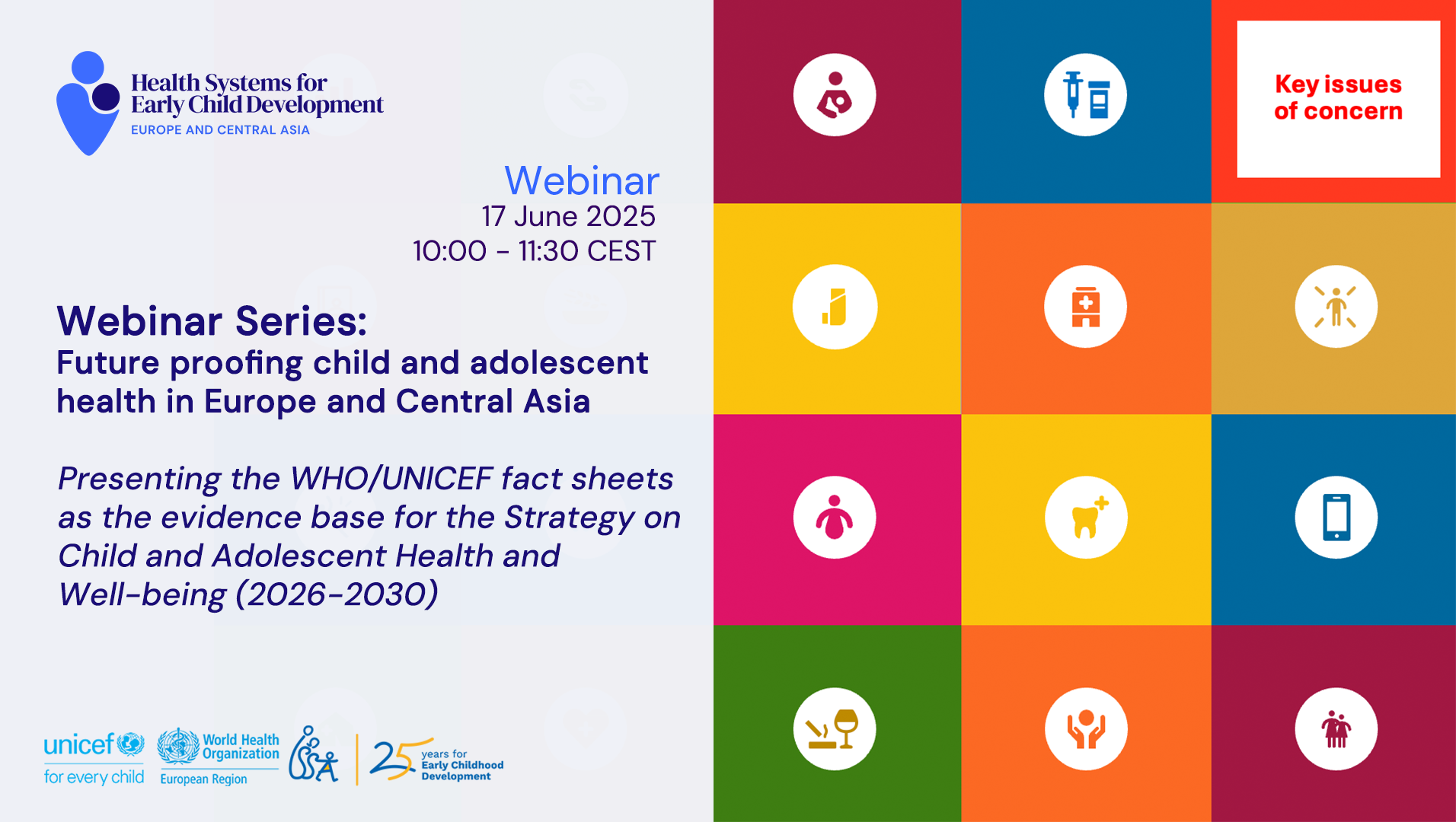
Recording available first webinar in series on future-proofing child and adolescent health in Europe and Central Asia 

Recording available first webinar in series on future-proofing child and adolescent health in Europe and Central Asia 

The first webinar in the webinar series on future-proofing child and adolescent health took place on 17 June 2025.
The webinar presented key findings from the new WHO/UNICEF fact sheets, which highlight urgent trends and emerging priorities for child and adolescent health and well-being in Europe and Central Asia. These evidence-based insights are informing the development of the forthcoming Regional Strategy on Child and Adolescent Health and Well-being (2026–2030).

In case you missed it—or would like to revisit the discussion—the full recording of the webinar is now available in English and Russian on the Health Systems for Early Childhood Development YouTube channel.

🎥 Watch the webinar here
🔎 You may view the PowerPoint slides here
💡 View the WHO/UNICEF fact sheets here

Upcoming webinars

The conversation continues with the next two webinars in the series:

  • Thursday 10 July, 10.00 CEST — A healthy start for a healthy life: orientation on the forth-coming WHO/UNICEF strategy for child and adolescent health and wellbeing in the European Region, and experiences from countries tackling child and adolescent health challenges 
  • Tuesday 16 September, 10.00 CEST — Implementation challenges and approaches

This webinar is organised by UNICEF Regional Office for Europe and Central Asia (ECARO), WHO Regional Office for Europe (WHO/Europe), and the International Step by Step Association (ISSA) under the auspices of the Health Systems for Early Childhood Development initiative. 

Posted by Didier in News
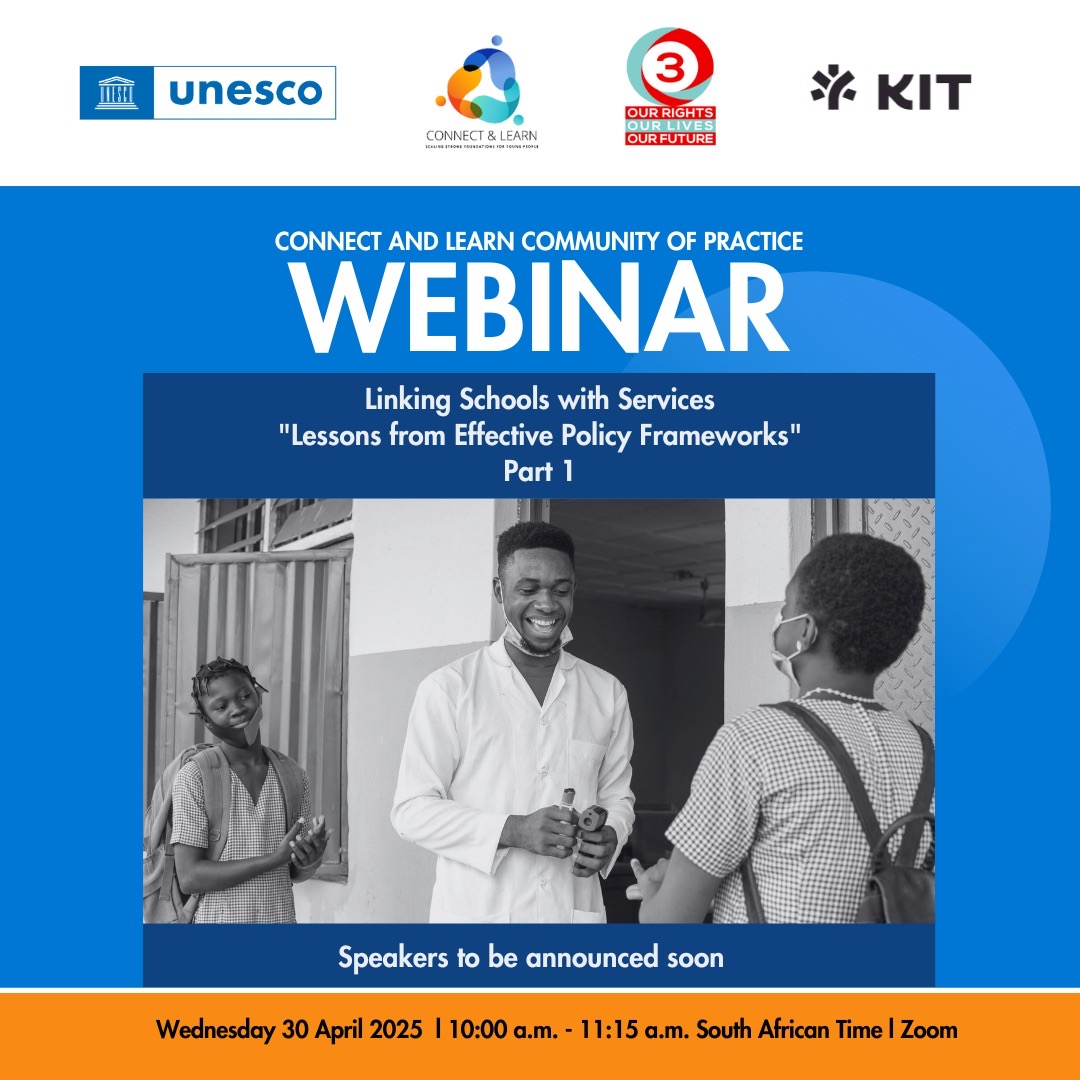
CoP Webinar on Linking Schools with Services (Part 1) – 30 April

CoP Webinar on Linking Schools with Services (Part 1) – 30 April

You are invited to the ‘Connect and Learn’ Community of Practice Webinar on Linking Schools with Services (Part 1) on Wednesday 30th April from 10:00 AM until 11:15 AM South Africa time.  

This session will:

  • Underscore the significance of linking education, health, and social protection services.
  • Discuss challenges and opportunities for referral mechanisms at the policy level.  
  • Identify key elements of effective referral policy frameworks. 
  • Share lessons learned from countries with strong referral mechanisms.

Please register in advance through this link.

After registering, you will receive a confirmation email with information about joining the webinar. 

Posted by Didier in News
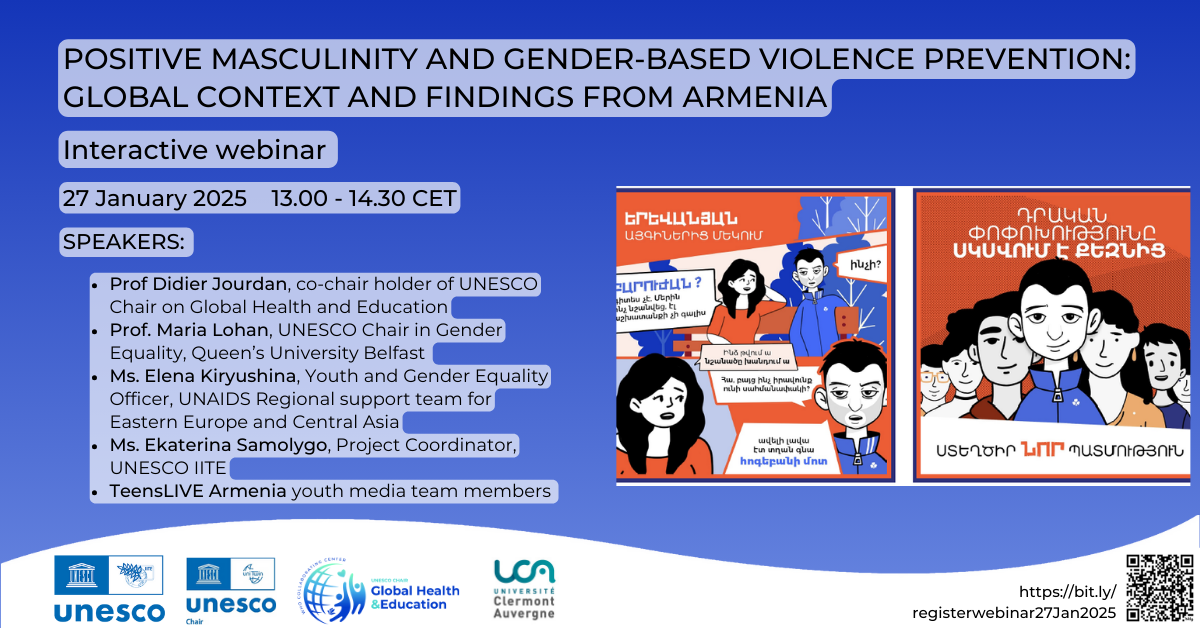
Webinar 27 January 2025 – Positive Masculinity and Gender-Based Violence Prevention: Global Context and Findings from Armenia

Webinar 27 January 2025 – Positive Masculinity and Gender-Based Violence Prevention: Global Context and Findings from Armenia

The persistence of harmful gender stereotypes and toxic masculinity is a significant global concern, contributing to various forms of gender-based violence and reinforcing unequal gender dynamics. The United Nations, UNESCO and UNAIDS have long recognized the importance of engaging men and boys in promoting gender equality. Through initiatives like the Joint Positive Masculinity Project, recently implemented in Armenia, these organizations aim to foster positive gender roles, encourage non-violent behaviour, and reduce harmful stereotypes worldwide. To effectively address these challenges, engaging young men and boys in reshaping societal norms is essential.

Under the UNESCO and UNAIDS Joint Positive Masculinity Project, a comprehensive social media campaign was launched in Armenia to engage young men aged 16-25 in a critical dialogue around masculinity, gender equality, and non-violence. This campaign was informed by a study of young men’s understanding of masculinity and aimed to challenge harmful masculinity stereotypes and promote positive behaviours by offering culturally relevant, interactive digital resources.

Speakers are:

  • Professor Didier Jourdan, Chair holder of the UNESCO Chair and WHO Collaborating Centre on Global Health and Education
  • Professor Maria Lohan, UNESCO Chair in Gender Equality, Queen’s University Belfast
  • Elena Kiryushina, Youth and Gender Equality Officer, UNAIDS Regional support team for Eastern Europe and Central Asia
  • Armi Mkrtchyan,Project Coordinator and Gender Officer at UNESCO IITE’s TeensLIVE Armenia
  • Ekaterina Samolygo, Project Coordinator, UNESCO Institute for Information Technologies in Education (IITE)

The webinar is moderated by Goof Buijs, manager of the UNESCO Chair on Global Health and Education.

The webinar will take place on Monday 27 January 2025 from 13.00 – 14.30 CEST in English.

Register for the webinar today. The link to the webinar will be sent to you after registration.

More information.

Posted by Didier in News
Webinar: Click, Connect and Prevent: Tackling Cyberbullying in Schools’ Part 2 – 10 December 2024

Webinar: Click, Connect and Prevent: Tackling Cyberbullying in Schools’ Part 2 – 10 December 2024

The next session of the ‘Connect and Learn’ Community of Practice webinar series:  “Click, Connect and Prevent: Tackling Cyberbullying in Schools” Part 2!  will take part on Tuesday 10 December 2024. This session will build on the previous discussion and focus on equipping educators and stakeholders with practical skills to prevent, recognize, and address cyberbullying using a whole school approach.

After registering, you will receive a confirmation email with details to join the webinar.

Posted by Didier in News
A Human-Centered Approach to Digital Education and Training – 29th ENETOSH Network Meeting on December 10, 1:00 – 3:30 (CET)

A Human-Centered Approach to Digital Education and Training – 29th ENETOSH Network Meeting on December 10, 1:00 – 3:30 (CET)

The digitalization of education and training brings significant opportunities but also raises concerns about the safety, health, and well-being of both learners and educators.

The European Network Education and Training in Occupational Safety and Health (ENETOSH) invites all to this joint event with the Department of Education and Health, Leuphana GmbH – Leuphana Universität Lüneburg (Lüneburg, Germany) and the UNESCO Chair Global Health & Education (Paris, France).

Programme

The 29th ENETOSH Network Meeting will address the themes in two focused sessions:

Session 1: Integrating AI in Education and Training Responsibly
The first session explores how digitalization—especially through AI-based tools—can be systematically and humanely integrated into educational practices. Highlighted will be Austria’s eEducation initiative by the Federal Ministry of Education, Science, and Research, which is currently piloting AI learning software in select “AI Pilot Schools.” Additionally, the session will introduce the “FriendlyTechCheck” dialog tool, developed as part of the “HUMAINE” project at the University of Duisburg-Essen. This tool assists organizations in assessing psychosocial risks and benefits when implementing AI technologies in the workplace.

Session 2: Improving the quality of education through the Good Healthy School Initiative (GHSI))
The second part highlights the Good Healthy Schools Initiative (GHSI), which is led by the Department of Education and Health of Leuphana GmbH, a subsidiary of Leuphana University Lüneburg, in cooperation with the UNESCO Chair for Global Health & Education, Paris (Goof Buijs). The GHSI aims to establish health and safety as an integral part of the school education framework to promote both health and learning outcomes. Through a holistic approach that strengthens the entire school community, the approach understands health as the basis for academic success. The initiative aims to build a network that brings together decision-makers from the education and health sectors to improve the mental, emotional, physical and social well-being of students and teachers, and thus improve the quality of education in the long term.

Registration Deadline: December 2, 2024
More information
Programme and online registration

Posted by Didier in News
Demo session Global Platform to Monitor School Health – 27 March 2024

Demo session Global Platform to Monitor School Health – 27 March 2024

The Global platform to monitor school health aims to support countries to obtain standardized metrics to monitor their school health programmes.  Aligned with the Global Standards for Health Promoting Schools, the platform was developed by WHO, UNESCO, UNICEF and the WFP to help countries:

  • Generate standardized data to inform priorities for school health;
  • Inform actions for improvements by linking results with recommendations;
  • Establish trends in school health policies and practices;
  • Facilitate dialogue between countries, international agencies, and others by exchanging information on school health policies and practices.

National school health coordinators, UN staff and development partners are invited to join.

Registration

For the ENGLISH version 13:00-14:00 CET March 27th 2024  https://who.zoom.us/webinar/register/WN_sOgEGY32T9yGrINip_kO1Q

For the FRENCH version 13:00-14:00 CET April 3d 2024 https://who.zoom.us/webinar/register/WN_XxO_QwVRS2CQIgM6fTAzkQ

More information

Flyer webinar Global Platform School Health in English

Flyer webinar Global Platform School Health in French

Visit the web page to learn more about the WHATs, WHYs and HOWs of the platform

Posted by Didier in News