health promoting schools

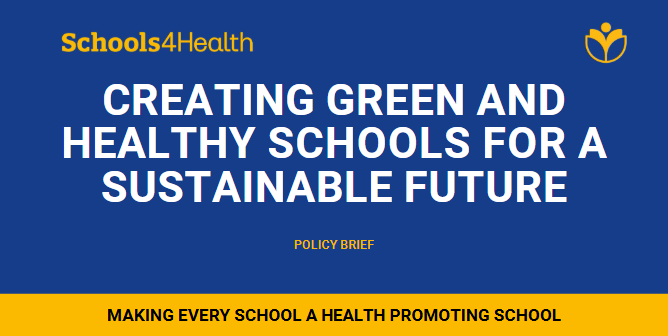
Schools4Health Policy Brief Published: Creating Green and Healthy Schools for a Sustainable Future

Schools4Health Policy Brief Published: Creating Green and Healthy Schools for a Sustainable Future

Source: Schools4Health

How can schools respond to the challenges of climate change, declining child wellbeing, and growing inequalities? The Schools4Health project argues that the answer lies in bringing health promotion and sustainability together under one whole-school approach.

Across Europe, nine in ten young people believe that tackling climate change will improve their wellbeing. Their voices remind us that health and sustainability are deeply connected — and that schools are uniquely placed to link these agendas.

While many schools already run health or environmental projects, they are often treated as separate initiatives. This fragmented approach risks missing opportunities to create a stronger, collective impact. The new Schools4Health Policy Brief Creating green and healthy schools for a sustainable future explores how schools can align these efforts, and how the Health Promoting Schools (HPS) framework can provide the foundation for this integration.

What does this mean in practice?

  • School gardens, green play areas, and outdoor learning that support both physical activity and environmental awareness.
  • Healthy eating programmes that also reduce food waste and promote sustainable choices.
  • Whole-school strategies that embed both wellbeing and sustainability into curricula, policies, and partnerships.
  • Student-led initiatives that empower young people to take action for their own health and the planet.

Lessons from Europe

The brief showcases examples of how countries are already moving in this direction:

  • Finland integrates wellbeing and sustainability as cross-cutting themes in its National Core Curriculum.
  • Italy has legislated for climate and sustainability education across all school levels.
  • The Netherlands is expanding its Healthy School Programme to cover environmental and sustainability issues.
  • Greece supports teachers with sustainability coordinators at district level.
  • Hungary promotes environmental awareness from an early age through its Green Kindergarten Network.

Why Schools4Health?

Schools4Health is an EU-funded project bringing together partners from 11 countries to strengthen the Health Promoting Schools approach across Europe. By supporting local pilots, cross-country exchanges, and policy work, the project shows how schools can be catalysts for healthier, fairer, and more sustainable societies.

Our third policy brief, Creating green and healthy schools for a sustainable future, sets out recommendations for policymakers, educators, and communities — from embedding health and sustainability in curricula to building cross-sector structures and empowering students as agents of change.

Read the full brief here.

Access the second brief here: Health Promoting Schools as a Lever for Equity in Education  and the first one at: Why Invest in Health Promoting Schools.

Find out more at www.schools4health.eu

Posted by Didier in News
International Round Table Explores Global Perspectives on Good Healthy Schools

International Round Table Explores Global Perspectives on Good Healthy Schools

On 9 April 2025, the Good Healthy Schools Initiative (GHSI) convened its first international Round Table, bringing together experts from across Europe, Africa, Asia, and North America to discuss how health can be systematically embedded into education systems. The online event, organized by Leuphana University of Lüneburg and funded by the German Social Accident Insurance (DGUV), marked a pivotal step in the Initiative’s ambition to promote “Good Healthy Schools” through international dialogue and cooperation.

Linking education and health

Moderated by Goof Buijs, manager of the UNESCO Chair Global Health & Education, the Round Table opened with a keynote by Prof. Dr. Peter Paulus, Director of the Center for Applied Health Sciences at Leuphana University and Head of the GHSI project. Paulus outlined the German model of the Good Healthy School and highlighted the strategic importance of linking education and health as mutually reinforcing dimensions of school development. His remarks set the stage for the international perspectives that followed.

Contributions came from representatives in Botswana, Hong Kong, Spain, Switzerland, Austria, Germany, and the United States, as well as from UNESCO’s Sections of Education Policy and Health and Education. The presentations highlighted innovative strategies ranging from UNESCO’s Happy Schools framework and the Icelandic Prevention Model to regional school health programs in Andalusia and cross-sectoral partnerships in Africa.

Health as a core dimension of educational quality

A recurring theme throughout the Round Table was the need to move beyond isolated initiatives and instead pursue systemic, policy-anchored approaches that view health as a core dimension of educational quality. Participants emphasized that sustainable progress requires intersectoral collaboration, cultural sensitivity, and above all, meaningful participation of children and young people. As Buijs stressed: “Don’t talk about them – talk with them.”

Breakout sessions provided space for in-depth dialogue on embedding health into school quality frameworks, financing strategies, and innovative partnerships. Across all contexts, participants highlighted funding challenges but also underlined the opportunities of global networks such as UNESCO, European Network Education and Training in Occupational Safety and Health (ENETOSH), and World Health Organisation (WHO) in creating shared platforms for learning and advocacy.

Call for international collaboration

The event concluded with a clear call for stronger international collaboration and the development of long-term alliances.

Feedback from participants confirmed the event’s value as a unique forum for exchange and co-creation. Preparations are already underway for a second international Round Table in December 2025, with even broader participation from UNESCO partners and organizations such as WHO, European Trade Union Committee for Education (ETUCE), and European Federation of Education Employers (EFEE).

The Round Table demonstrated the growing momentum of the Good Healthy Schools Initiative and reaffirmed the global relevance of embedding health and well-being at the heart of education systems.

Posted by Didier in News
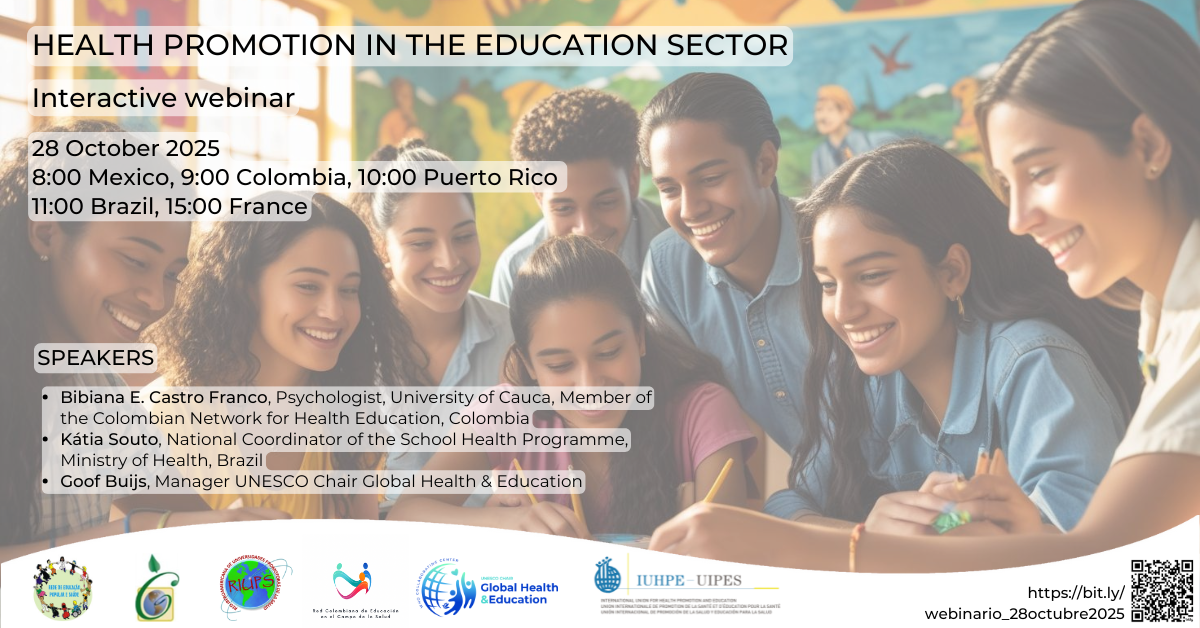
Webinar 28 October 2025 – Health promotion in the education sector

Webinar 28 October 2025 – Health promotion in the education sector

Time: 8.00 – 9.30 Mexico, 9.00 – 10.30 Colombia, 10.00 – 11.30 Puerto Rico, 11.00 – 12.30 Brazil, 15.00 – 16.30 France

Language: The webinar will be held in Spanish and Portuguese. Translation will be available in 50+ languages, including English, French, Portuguese and Spanish. We will use a translation app based on AI.

RegistrationRegister here. Registration is free. The link to the webinar will be sent to you after registration.

Información en español, Informações em português


Speakers

Moderator

Prof. Dr. Fernando Peñaranda Correa. He is a doctor, holds a master’s degree in public health, a master’s degree in education and social development, and a doctorate in social sciences, childhood and youth. He is a full professor and senior researcher in the Health and Society Research Group at the National School of Public Health at the University of Antioquia. He is the coordinator of the health education emphasis in the Master’s in Public Health programme. He has taught undergraduate and postgraduate programmes at the Faculty and other universities in the country on the following topics: epistemology, qualitative research, ethics and social justice, public health, health promotion, and health education. He has written numerous articles, book chapters, and books in the areas of health education, qualitative research, ethics, public health, and social justice.

Bibiana E. Castro Franco. Psychologist, specialising in social psychology, Master’s degree in Public Health and Doctorate in Human Sciences. Lecturer at the University of Cauca. Department of Education and Pedagogy. Researcher with the Popular and Community Education Group. Member of the Colombian Network for Health Education. CLACSO Working Group on International Health and Health Sovereignty.

Kátia Souto, National Coordinator of the School Health Programme, Ministry of Health, Brazil

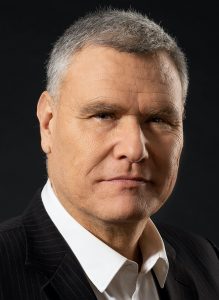
Goof Buijs. Manager of the UNESCO Chair Global Health & Education. After finishing his Master study in Human Nutrition his first job was teaching health science at the Amsterdam teacher trainer institute. Next he moved into the field of health promotion, as health promotion officer in Amsterdam. At the Netherlands Institute for Health Promotion NIGZ he specialized in school health promotion, first on the Dutch level to introduce the national health promoting school programme and leading several European projects. In 2007 he became the manager of the Schools for Health (SHE) network until 2017. In 2018, with prof Didier Jourdan, he set up the UNESCO Chair Global Health & Education, also the WHO Collaborating Centre. His specialisation is bringing health and education sectors together. He is an experienced networker, expert in co-creation, trainer, and organizer of local and global events. He supports cooperation among people, focusing on everyone’s talents and uniqueness. He is an environmental activist for most of his life.


Summary

During this webinar the speakers will analyse experiences with health promotion in the education sector in various countries to identify achievements, challenges and opportunities. Each speaker will share their respective experiences, identifying the progress, strengths, difficulties and challenges involved in coordinating the education and health sectors to promote health promotion and health education in schools. This will be followed by time for attendees to ask questions and make comments on the presentations given by the speakers.


Latin American Network for the Revitalisation of Health Education

This webinar is a part of the “Latin American Network for the Revitalisation of Health Education”. This initiative is being promoted with the participation of the UNESCO Chair on Global Health and Education, the Inter-American Consortium of Universities and Training Centers for Health Education and Health Promotion (CIUEPS), the Brazilian Network of Popular Health Education, the Colombian Network of Health Education and the Regional Office for Latin America of the International Union of Health Promotion and Education (IUHPE/ORLA), with the following objectives:

  • Promote health education at national and international levels, as a fundamental dimension of the health disciplines, the educational sciences and the social and human sciences.
  • To recuperate the Latin American production and position it in the regional level, which implies promoting its critical and decolonial approaches. A health education that advocates for social transformation towards a more just and equitable society that guarantees well-being and a life with dignity.
  • Promote the articulation of the education and health sectors to strengthen the actions of each of these sectors to promote health education, by recognizing education and health as two inalienable, synergistic and interdependent human rights.
  • Strengthen the theoretical, political and ethical foundations of health education as a requirement for a responsible, productive and ethical pedagogical practice.
  • To generate a setting for the articulation of academia and civil society that allows Latin American integration in order to share experiences, knowledge and aspirations framed in a collective purpose.
  • To promote national and international integration with respect to health education as a means for mutual learning and solidarity, and to facilitate cooperative actions in the development of academic-scientific events, research and training processes.

The webinars, open to all interested stakeholders, are a component of the program. They are experiential sessions, lasting 60-90 minutes, with guest speakers who present their reflections on two or three problematic questions to encourage audience participation. Five webinars have been scheduled for this first stage of the program, with an interval of 2 months between each one.

Watch the recordings of previous webinars:

Posted by Didier in News
Why Schools Should Prioritise Health: Expert Voices from the Schools4Health Initiative

Why Schools Should Prioritise Health: Expert Voices from the Schools4Health Initiative

What makes the Health Promoting School (HPS) approach so essential today? Why should both policymakers and schools invest in it—and how does it help promote core European values like participation, equity, and inclusion? As part of the Schools4Health initiative, partners sat down with leading experts in education and public health to explore these questions and more, delving into what it takes to successfully implement the HPS approach and how projects like Schools4Health can support broader efforts led by organisations such as the WHO.

These are some of the questions the Schools4Health initiative is exploring as part of its mission to embed the Health Promoting School (HPS) approach into education systems across Europe. As part of this effort, partners recently invited two leading experts in education and public health to share their views on why now is the time to integrate health into the very fabric of school life.

From mental wellbeing and physical activity to healthy nutrition, health affects every aspect of a young person’s ability to learn and thrive. And yet, despite mounting evidence, many school systems continue to treat health as an add-on rather than a core condition for learning and development.

In a series of exclusive interviews recorded at the Schools4Health consortium meeting, advisory board members Professor Peter Paulus (Leuphana University Lüneburg) and Trinette Lee (WHO) reflect on the urgent need to rethink how we structure education and how a shift to the HPS model can lead to better outcomes not just for students and teachers, but for society.

The interviews kick off a new video series exploring the role of health in education through the eyes of those shaping policy and practice at the highest level.

Curious about their insights? Watch the first video on our LinkedIn page and follow Schools4Health on LinkedIn to explore the series to learn how schools can become healthier, more inclusive places to grow and learn.

For more insights on the HPS approach, discover the new Schools4Health policy brief, Why Invest in Health Promoting Schools, which outlines why it is a crucial and cost-effective strategy to create healthier learning environments.

Learn more at www.schools4health.eu

Posted by Didier in News
Schools4Health Education and Health Partners Strengthen Commitment to Health-Promoting Schools Across Europe

Schools4Health Education and Health Partners Strengthen Commitment to Health-Promoting Schools Across Europe

How can schools, policymakers, and communities work together to make every school a Health-Promoting School? This was the central question at the recent Schools4Health consortium meeting, where partners explored ways to ensure the long-term impact of the project.

Discussions focused on:
✔️ Strengthening collaboration between health and education sectors to embed health promotion in school policies and practices
✔️ Scaling up successful pilot initiatives that improve student well-being through nutrition, physical activity, and mental health support as an entry point to implementing the health-promoting school approach
✔️ Ensuring the sustainability of the Health Promoting Schools approach beyond the project’s duration

Over the coming months, Schools4Health will continue working with partners across Europe to turn these discussions into action, helping schools create environments where students can thrive.

Read the latest update with the press release about the meeting.

Posted by Didier in News
Article on mapping research literature health promotion in schools

Article on mapping research literature health promotion in schools

Recently the article ‘Health promotion in the school context: a scientific mapping of the literature[1] is published in Health Education (31 October 2024).

The study presents an overview of research literature on health promotion in schools, utilizing metadata extracted from 4,328 publications indexed in the Scopus database over the past 35 years. A bibliometric approach was used to analyze the development and current state of using publication and citation data. A structured keyword search was conducted in the Scopus database to retrieve relevant publications in the field. Frequency counts, rank-ordered tables, and time series charts were used to illustrate the dynamic growth of publication and citation data, the core journals, the leading countries, and the most frequently used keywords in research on health promotion in school contexts. A series of social network analyses was conducted to explore and visualize the social, intellectual, and conceptual structure of the field.

Findings demonstrate that health promotion in school contexts is a growing research field that has gained significant momentum in recent years. The research in this field is widely distributed internationally, but research output is dominated by the US and other English-speaking countries. The study reveals a trend towards increased collaboration among research groups. The level of international collaboration varies. The research field is highly interdisciplinary and the main research themes addressed in the literature include mental health, well-being, and quality of life; health behaviors; oral health education; sexual and reproductive education; and general health promotion and health education in schools. This is the first study to map the development of a research field with growing recognition. It provides a comprehensive overview of the emerging field of health promotion in school contexts and its progress over time, contributing to the organization of the research domain. The study demonstrates the need for a new framework for health promotion research that supports the sustainability of health promotion research in schools.

Read the full article

Posted by Didier in News
Webinar: Click, Connect and Prevent: Tackling Cyberbullying in Schools’ Part 2 – 10 December 2024

Webinar: Click, Connect and Prevent: Tackling Cyberbullying in Schools’ Part 2 – 10 December 2024

The next session of the ‘Connect and Learn’ Community of Practice webinar series:  “Click, Connect and Prevent: Tackling Cyberbullying in Schools” Part 2!  will take part on Tuesday 10 December 2024. This session will build on the previous discussion and focus on equipping educators and stakeholders with practical skills to prevent, recognize, and address cyberbullying using a whole school approach.

After registering, you will receive a confirmation email with details to join the webinar.

Posted by Didier in News
Demo session Global Platform to Monitor School Health – 27 March 2024

Demo session Global Platform to Monitor School Health – 27 March 2024

The Global platform to monitor school health aims to support countries to obtain standardized metrics to monitor their school health programmes.  Aligned with the Global Standards for Health Promoting Schools, the platform was developed by WHO, UNESCO, UNICEF and the WFP to help countries:

  • Generate standardized data to inform priorities for school health;
  • Inform actions for improvements by linking results with recommendations;
  • Establish trends in school health policies and practices;
  • Facilitate dialogue between countries, international agencies, and others by exchanging information on school health policies and practices.

National school health coordinators, UN staff and development partners are invited to join.

Registration

For the ENGLISH version 13:00-14:00 CET March 27th 2024  https://who.zoom.us/webinar/register/WN_sOgEGY32T9yGrINip_kO1Q

For the FRENCH version 13:00-14:00 CET April 3d 2024 https://who.zoom.us/webinar/register/WN_XxO_QwVRS2CQIgM6fTAzkQ

More information

Flyer webinar Global Platform School Health in English

Flyer webinar Global Platform School Health in French

Visit the web page to learn more about the WHATs, WHYs and HOWs of the platform

Posted by Didier in News
SHE monitoring report on implementation of school health promotion

SHE monitoring report on implementation of school health promotion

In December 2021 the Schools for Health in Europe Network Foundation (SHE) published a report on barriers and facilitators for the implementation of school health promotion in Europe: SHE Monitoring Report.   

The aim was to get a deeper understanding of the current influencing factors for the implementation of school health promotion. The report presents the main findings of this study and discusses insights and recommendations for further improving the implementation. Five countries participated in the study (Estonia, Norway, Portugal, Slovenia, and Wales). It can be concluded that even though in each country other (combinations of) factors influence the implementation of school health promotion, similarities do exist. These similarities have led to a number of insights and recommendations, which may be helpful for all countries. 

Posted by Didier in News
Webinar Strategies for School Health Promotion during COVID-19 – 30 September 2021

Webinar Strategies for School Health Promotion during COVID-19 – 30 September 2021

The COVID-19 pandemic has severely impacted schools all over the world. Schools in many countries closed in haste and had to create virtual learning opportunities for their students. The reopening of schools is taking place in various speeds and with different guidance at national and/or local level.

The UNESCO Chair Global Health & Education gathered the experiences and opinions of education and health professionals about  reopening schools safely and/or to keeping them open. The survey explored the public health measures that have been put in place in schools; communication of guidance at national and/or local level, and the facilitators or barriers to safe reopening. Nicola Gray (Affiliated researcher, UNESCO Chair Global Health & Education; Senior Lecturer, University of Huddersfield, UK) will provide a preview of the results of this survey on the safe reopening of schools during COVID-19. 

The WHO-Europe Technical Advisory Group for schooling during COVID-19 recommends that ‘the principles of health-promoting schools (HPS) are even more important in a pandemic’. However, moving from recognition of HPS values to putting these into practice is challenging. Veronica Velasco (Assistant professor, Department of Psychology, University of Milano-Bicocca, Italy) wrote a new document on School Health Promotion during COVID-19 for the Schools for Health in Europe network (SHE). The relevance of the HPS approach during the COVID-19 pandemic will be discussed and implementation strategies based on the HPS approach will be presented.

During this webinar the experts will explore the following questions:

  1. What are the experiences of education and health professionals around the world concerning the safe reopening of schools?
  2. Why is the HPS approach relevant during the COVID-19 pandemic and how can HPS be implemented?
  3. What can we learn to better prepare schools for future epidemics and disasters?

This webinar is organised by the Schools for Health in Europe Network Foundation (SHE), the UNESCO Chair Global Health & Education, the University of Huddersfield and the University of Milano-Bicocca.

The webinar will take place on 30 September 2021 from 14.00 – 15.00 CEST.

Join the webinar. This webinar will also be broadcasted live on our YouTube channel.

More information

Posted by Didier in News