Didier

Article: Health promotion research has come of age!

Article: Health promotion research has come of age!

Structuring the field based on the practices of health promotion researchers

In the article “Health promotion research has come of age! Structuring the field based on the practices of health promotion researchers” which was recently published in Global Health Promotion, Louise Potvin and Didier Jourdan propose three dimensions to further structure health promotion research.

There is no well-defined knowledge base for health promotion and no widely agreed knowledge development methods. During the past decades, researchers from various disciplinary backgrounds have used their disciplinary-based research methods and theories to conduct studies about the various practices that are associated with health promotion. Although health promotion research has acquired many attributes of a distinct field, researching practices from various disciplinary perspectives is not sufficient to create a coherent knowledge base for health promotion.

Therefore the authors propose three dimensions to further structure health promotion research.

  • The first relates to the object for which knowledge is produced. For health promotion research this relates to health social practices.
  • The second dimension relates to the purpose and ethics of research. In the case of health promotion research it pursues the dual purpose of producing knowledge (epistemic aim) and contributing to social changes (transformative aim).
  • The third dimension concerns the knowledge produced and the conditions for valid knowledge. In the case of health promotion research, the condition of knowledge production should include a recognition of the complexity of social practice and the necessary dialogue between scientific.

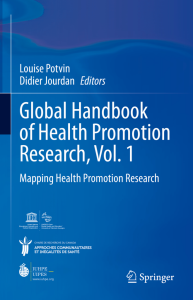
The authors propose a bottom-up process for structuring the field through the creation of a ‘Global Handbook of Health Promotion Research’ that would draw on the research practices of those involved in health promotion research.

Read the whole article

Posted by Didier in News
New Strategic Development Plan EuroHealthNet

New Strategic Development Plan EuroHealthNet

EuroHealthNet has launched its new Strategic Development Plan, which sets out the principles and priorities which will guide their work over the next five years.

EuroHealthNet members (over 60 organisations, institutes, and authorities working on public health, disease prevention, promoting health and wellbeing, and reducing inequalities) have assessed how the Partnership should move forward. New skills, capacities, and competences will be needed and are crucial. The new Strategic Development Plan, describes how the Partnership can continue working together to achieve real and lasting change to improve health and reduce health inequalities in Europe.

EuroHealthNet will focus on: 

  • The application of the equity lens across health and other policies and measures; supporting the ‘economy of wellbeing’, as well as a ‘whole of society’ approach.
  • Novel ways to promote health and prevent diseases. Making solutions attractive and sustainable, whilst contributing to the transformation of health and social protection systems.  
  • The social, economic, environmental, cultural, commercial, behavioural, and political determinants of health, which allows us to be agile and responsive to the diverse threats to health equity. 

They have defined five priority areas:

  • Health equity.
  • Non-communicable diseases.
  • The climate crisis.
  • Prevention and promotion.
  • Life course.

And two cross-cutting themes:

  • Mental health
  • Digital inclusion

More information

Read the Strategic Development Plan

Posted by Didier in News
Article: Teacher Care is a Lot More Than Self-Care

Article: Teacher Care is a Lot More Than Self-Care

Published 2 November 2021, on EdSurge

In the article “School Leaders Take Note: Teacher Care is a Lot More Than Self-Care” the author, Sean Slade, stresses the importance of improving the environments educators are in everyday, in stead of focusing on solutions revolving around “self-care”.

Educators are exhausted but the only solutions they are presented revolve around “self-care,” i.e., rest, relaxation, meditation, physical activity and yoga. These strategies are helpful in addressing the wound, but they do little to nothing to address the cause.

Instead the group climate and culture of schools should be addressed. The environments that educators find themselves in everyday should be improved and at a minimum decrease the stress and increase the supports available in that setting. Then collaboratively, the systems that has been fostered that have caused much of the stress in the first place can be addressed.

How can this be done?

By starting to enhance and improve the ways educators interact and the ways they react to one another. If schools can be built into places of care, support and positive interactions, they buffer the system stresses, and support the self-care that may take place.

Read the whole article

Posted by Didier in News
Lifelong learning for health as a key to building sustainable, equitable, inclusive and resilient cities

Lifelong learning for health as a key to building sustainable, equitable, inclusive and resilient cities

From emergency to resilience: Building healthy and resilient cities through learning – 5th UNESCO International Conference on Learning Cities

The South Korean city of Yeonsu, a member of UNESCO’s Global Network of Learning Cities (GNLC), hosted the Fifth International Conference on Learning Cities from 27 to 30 October 2021. The event brought together education experts and representatives from the 229 members of UNESCO’s GNLC to discuss the conference theme “From emergency to resilience: Building healthy and resilient cities through learning”. The aim was to discuss how cities can promote health education and contribute to emergency responses, such as those implemented during the COVID-19 pandemic. With more than half of humanity living in urban areas, cities play a key role in responding to health crises.

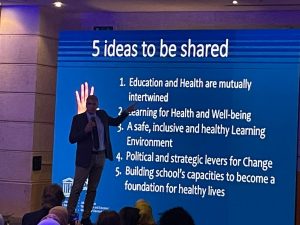
In his key-note during the plenary session on 28 October, Didier Jourdan recalled the central role of lifelong learning for health in building healthy, equitable, inclusive, sustainable and resilient cities. The health crisis has served as an eye-opener on the challenges of lifelong learning for health and well-being issues. It reminded us that we cannot make people healthy without them or against them. In addition to the issues of urban planning, transport, housing, social services and water supply, which are all crucial determinants of people’s health, cities have an equally crucial role to play in their ability to develop or host ‘learning for health and well-being’ policies and interventions.

Didier Jourdan during his presentation distinguished two inseparable dimensions for learning for health: 

  • It is a means of developing people’s capacity to take responsibility for their own health, which includes knowing how to access, understand, evaluate and apply relevant information. This set of knowledge and skills is often referred to as health literacy;
  • It is also an essential component of citizenship education. Health is not just a matter of individual behaviour and choice. Because one’s choices and actions potentially affect others in the community and the world at large, health involves both individual and collective responsibility and engagement in health-related social and environmental decisions.

The recording of Didier Jourdan’s key note (start at 3h 23 min)

The recording of the Declaration (start at 55 min 45 sec)

More information:

Didier Jourdan speaking at the plenary session on 28 October 2021
Clermont-Ferrand received the 2021 Learning City Award. Didier Jourdan with David Atchoarena, Director of the UNESCO Institute for Lifelong Learning.
Posted by Didier in News
Join the SDG4Youth Network

Join the SDG4Youth Network

Call for applications for young leaders, 18-29 years old, who are actively working to contribute to the Education 2030 Agenda for Sustainable Development with youth/student networks.

The SDG4Youth network aims to include young education activists in shaping global education policies through engagement in the multi-stakeholder SDG 4 Education 2030 High-level Steering Committee, while establishing the network as an accountable and representative youth and students platform. 

Around the world, young people are driving change and claiming fundamental freedoms and rights; improving conditions for them and their communities; as well as opportunities to learn, work and participate in decisions that affect them. Young people have placed education as a key concern and challenge affecting their lives.

Creating an SDG4Youth Network was born out of the recognition that young people are key partners and actors in creating a better future for all through education in their countries and communities and should have an equal seat at the decision-making table. As such, SDG4Youth will have a strong emphasis on co-creation with youth and students, by involving young people from the start of the initiative network to shape on how they would like to see the network developed, operationalized and sustained. The network will also forge strong links with the regional youth and education initiatives and strategies.

More information about the initiative

More details on criteria in the sign-up form. 1 November 2021 is the deadline for the first intake.

Posted by Didier in News
Antidote COVID-19 game launched by WHO and Psyon Games

Antidote COVID-19 game launched by WHO and Psyon Games

WHO and Psyon Games jointly launched a new tower defense game called the Antidote COVID-19 to turn complex, scientific information into a fun learning experience. During the course of the game, players will learn about their immune system, pathogens, vaccines and how to protect themselves from COVID-19.

The game comes at a critical point of the pandemic where misinformation is hindering COVID-19 vaccine acceptance and adherence to other public health measures due to fear, mistrust and doubt. By putting players in the driver’s seat, the game urges everyone to play a role in fighting harmful misinformation online, and learning and sharing the facts from trusted sources of information.

The game starts just before the pandemic begins. The player is recruited to halt the spread of SARS-COV-2, the virus that causes COVID-19, by developing vaccines and helping the human immune system fight off the virus. Based on real events, this online adventure takes the player to the frontline of science, ultimately providing lifesaving information in the palms of their hands. 

More information and to download the game

Posted by Didier in News
UNICEF Report – The State of the World’s Children 2021

UNICEF Report – The State of the World’s Children 2021

In my mind – Promoting, protecting and caring for children’s mental health.

UNICEF recently published a report on the mental health of children around the world. The COVID-19 pandemic has raised concerns about the mental health of a generation of children. But the pandemic may represent the tip of a mental health iceberg – an iceberg we have ignored for far too long. 

The State of the World’s Children 2021 examines the mental health of children, adolescents and their caregivers. It highlights the risks and protective factors at key moments in the life course and analyses the social determinants that influence mental health and well-being.

In addition, the report calls for commitment, communication and action as part of a comprehensive approach to promote good mental health for every child, protect vulnerable children and care for children facing the greatest challenges.

Click here for an interactive view of data from the report

The report is available in EnglishFrenchSpanish and Arabic.

For parents

Click here for tips and resources on how to talk to your child about mental health.

For young people
Click here for tips on reaching out, providing support and breaking the stigma around mental health.

Posted by Didier in News
Online pre-conference Genuine Participation and the Transformational Potential of Health Promotion – 10 November 2021

Online pre-conference Genuine Participation and the Transformational Potential of Health Promotion – 10 November 2021

Join the preconference Genuine Participation and the Transformational Potential of Health Promotion – Coronavirus Politics on 10 November 2021 from 9.00 CET. The focus of this pre-conference is to open new perspectives on genuine participation as a means to highlight the transformational potential of Health Promotion. By shifting participation as a mantra to participation as a practice this pre-conference aims at establishing a stronger focus to inclusion as part of health-for-all-policies. In this session we will explore different perspectives to the future of the transformational potential of health promotion focusing on the global and the national level.

Next to these objectives, we wish to create a space that supports international networking among professionals and researchers interested in advancing participatory community-based public health interventions.

The pre-conference is organized by the EUPHA Health Promotion section, UNESCO Chair Global Health & Education and International Institute, University of Michigan during the 14th European Public Health Conference (Glasgow 10-12 November)

For more information and registration

Posted by Didier in News
Addressing hate speech through education – Multi-stakeholder online forum

Addressing hate speech through education – Multi-stakeholder online forum

Hate speech is on the rise worldwide, with the potential to incite violence, undermine social cohesion and tolerance, and cause psychological, emotional and physical harm based on xenophobia, racism, antisemitism, anti-Muslim hatred and other forms of intolerance and discrimination (UN, 2020). History has shown us that genocide and other atrocity crimes begin with words – there is a collective responsibility to address hate speech in the present day to prevent further violence in the future.

As part of the implementation of the United Nations Strategy and Plan of Action on Hate speech, UNESCO and the UN Office on the Prevention of Genocide and the Responsibility to Protect will convene the “Global Multi-stakeholder Forum on addressing hate speech through education” on 30 September and 1 October 2021. The Forum will serve to provide inputs for the upcoming “Global Education Ministers Conference on addressing hate speech through education” due to take place on 26 October 2021.

The Forum will encompass two days of online dialogues, bringing together teachers/educators, youth, civil society organizations, human rights experts, tech and social media companies and government representatives, with a view to promote meaningful engagement, discuss the role of education in addressing hate speech and identify key recommendations for a way forward ahead of the Ministerial Conference.

To attend this public event please register on the link below as soon as possible as there are limited places: REGISTER HERE.

More info about addressing hate speech through education by UNESCO, here.

Posted by Didier in News
The UNESCO Chair endorses The Jena Declaration

The UNESCO Chair endorses The Jena Declaration

The UNESCO Chair Global Health & Education endorses The Jena Declaration which calls for a global mobilization to attain the United Nations Sustainable Development Goals (SDGs) before 2030. It wants to spur communities around the world to choose pathways to sustainability through a new culturally and regionally sensitive, bottom-up approach.

The Jena Declaration (TJD) establishes guidelines and practices to accelerate progress to attain the United Nations Sustainable Development Goals (SDGs). It calls for enabling fundamental change in the everyday actions of hundreds of millions of people all over the world.  Specifically, the declaration aims to stimulate more culturally-sensitive policies and programs that enhance, promote and facilitate grass roots movements that lie at the heart of such mobilization. By respecting cultural and regional diversities, the aim is to exceed the expectations of the UN SDGs before 2030, and to set the table for even greater success with each successive decade.

Since its adoption in March 2021, the Declaration has been endorsed by a considerable number of international organizations and initiatives in the fields of science, arts, and economics. For this movement to be successful, it is crucial that voices that have been under-represented in the development of top-down approaches to solving sustainability issues be fully engaged and heard. Young people from around the world and especially from the Global South are invited to join and to participate fully in the development of programs and policies that apply The Jena Declaration principles. People everywhere are encouraged to support The Jena Declaration and to add their voice by adding their signature.

More information: https://www.thejenadeclaration.org

Posted by Didier in News