wellbeing

New Strategic Development Plan EuroHealthNet

New Strategic Development Plan EuroHealthNet

EuroHealthNet has launched its new Strategic Development Plan, which sets out the principles and priorities which will guide their work over the next five years.

EuroHealthNet members (over 60 organisations, institutes, and authorities working on public health, disease prevention, promoting health and wellbeing, and reducing inequalities) have assessed how the Partnership should move forward. New skills, capacities, and competences will be needed and are crucial. The new Strategic Development Plan, describes how the Partnership can continue working together to achieve real and lasting change to improve health and reduce health inequalities in Europe.

EuroHealthNet will focus on: 

  • The application of the equity lens across health and other policies and measures; supporting the ‘economy of wellbeing’, as well as a ‘whole of society’ approach.
  • Novel ways to promote health and prevent diseases. Making solutions attractive and sustainable, whilst contributing to the transformation of health and social protection systems.  
  • The social, economic, environmental, cultural, commercial, behavioural, and political determinants of health, which allows us to be agile and responsive to the diverse threats to health equity. 

They have defined five priority areas:

  • Health equity.
  • Non-communicable diseases.
  • The climate crisis.
  • Prevention and promotion.
  • Life course.

And two cross-cutting themes:

  • Mental health
  • Digital inclusion

More information

Read the Strategic Development Plan

Posted by Didier in News
Lifelong learning for health as a key to building sustainable, equitable, inclusive and resilient cities

Lifelong learning for health as a key to building sustainable, equitable, inclusive and resilient cities

From emergency to resilience: Building healthy and resilient cities through learning – 5th UNESCO International Conference on Learning Cities

The South Korean city of Yeonsu, a member of UNESCO’s Global Network of Learning Cities (GNLC), hosted the Fifth International Conference on Learning Cities from 27 to 30 October 2021. The event brought together education experts and representatives from the 229 members of UNESCO’s GNLC to discuss the conference theme “From emergency to resilience: Building healthy and resilient cities through learning”. The aim was to discuss how cities can promote health education and contribute to emergency responses, such as those implemented during the COVID-19 pandemic. With more than half of humanity living in urban areas, cities play a key role in responding to health crises.

In his key-note during the plenary session on 28 October, Didier Jourdan recalled the central role of lifelong learning for health in building healthy, equitable, inclusive, sustainable and resilient cities. The health crisis has served as an eye-opener on the challenges of lifelong learning for health and well-being issues. It reminded us that we cannot make people healthy without them or against them. In addition to the issues of urban planning, transport, housing, social services and water supply, which are all crucial determinants of people’s health, cities have an equally crucial role to play in their ability to develop or host ‘learning for health and well-being’ policies and interventions.

Didier Jourdan during his presentation distinguished two inseparable dimensions for learning for health: 

  • It is a means of developing people’s capacity to take responsibility for their own health, which includes knowing how to access, understand, evaluate and apply relevant information. This set of knowledge and skills is often referred to as health literacy;
  • It is also an essential component of citizenship education. Health is not just a matter of individual behaviour and choice. Because one’s choices and actions potentially affect others in the community and the world at large, health involves both individual and collective responsibility and engagement in health-related social and environmental decisions.

The recording of Didier Jourdan’s key note (start at 3h 23 min)

The recording of the Declaration (start at 55 min 45 sec)

More information:

Didier Jourdan speaking at the plenary session on 28 October 2021
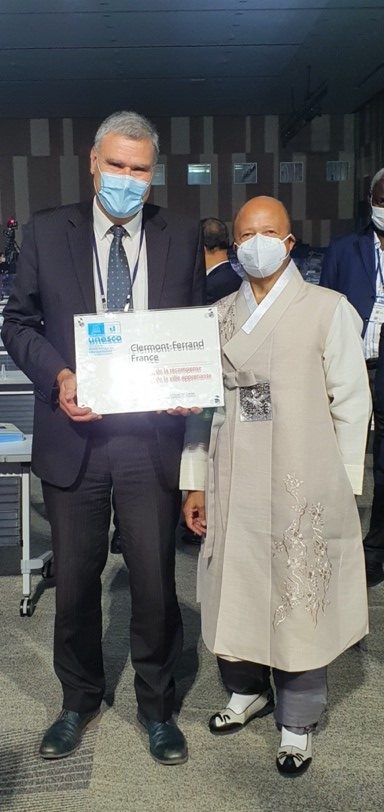
Clermont-Ferrand received the 2021 Learning City Award. Didier Jourdan with David Atchoarena, Director of the UNESCO Institute for Lifelong Learning.
Posted by Didier in News
Involve children and young people in assessing the impact of school closures on their wellbeing and developing strategies for post-COVID-19 schooling

Involve children and young people in assessing the impact of school closures on their wellbeing and developing strategies for post-COVID-19 schooling

Article published in MDPI on 5 September 2021

Nearly 200 countries have implemented school closures to reduce the spread of the COVID-19 coronavirus. Although these closures have seemed necessary, there have been serious concerns about their effects on the well-being of children and adolescents. To truly understand the impact of these closures on children’s and adolescent’s well-being, and their suggestions for the future, it is important to adopt new approaches to collecting data that will ensure the right of children and adolescents to be heard on issues that affect them.

Current methods of assessing the impacts of school closure are dominated by the collection of information about children and adolescents, mainly using existing wellbeing indicators and related questionnaire surveys. While these sources of information are important, they provide only a limited understanding of how children and adolescents have experienced school closure, especially if they have been produced using measures developed solely by adults. There is a need for information produced by children and adolescents themselves, which may need to go beyond existing theoretical frameworks of wellbeing that predate COVID-19.

By gathering information from children and adolescents, the authors of this paper[1] show that we can more effectively guide the development and evaluation of public health policies and identify solutions to mitigate the negative impacts of school closures, or to recognise and respond to any positive effects.

Read the article

[1] Paakkari, L., Jourdan, D., Inchley, J., & Torppa, M. (2021). The Impact of School Closure on Adolescents’ Wellbeing, and Steps toward to a New Normal : The Need for an Assessment Tool Update? Adolescents1(3), 360‑362. https://doi.org/10.3390/adolescents1030027

Posted by Didier in News
Survey on the UNESCO Strategy on Education for Health and Well-being

Survey on the UNESCO Strategy on Education for Health and Well-being

UNESCO is currently assessing its Strategy on Education for Health and Well-Being (2016-2021) with a view to updating it to reflect changes in the international health and development agenda, including the Covid-19 pandemic and the new UNAIDS Strategy 2022-2026.

As part of this process, UNESCO is reaching out to internal and external stakeholders – at national, regional and global levels. You are invited to contribute and share your views before 7 September 2021 via this link.

Posted by Didier in News
Sexuality education in the digital space and Health & Wellbeing for young people in times of COVID-19 – UNESCO publications

Sexuality education in the digital space and Health & Wellbeing for young people in times of COVID-19 – UNESCO publications

UNESCO recently published a range of products that have been developed relating to a series of work exploring sexuality education in the digital space. Also a report was published based on a consultation on the health and wellbeing challenges facing young people in the context of school closures and other lockdown measures in the time of COVID-19.

The products related to exploring sexuality education in the digital space:

  • Switched On Symposium Report:A report from a 3-day global symposium held in February (jointly by UNESCO, UNFPA, IPPF European Network and BZgA). The symposium explored the opportunities and challenges for capitalizing on digital spaces to strengthen efforts to deliver comprehensive sexuality education to adolescents and young people.
  • A series of posters showcasing examples of digital spaces delivering sexuality educationto adolescents and young people across the world. This series of posters featured as part of the exhibition at the symposium ‘Switched On. The posters are snapshots of digital sexuality education providers who are doing just that – taking sexuality education to the digital spaces where adolescents and young people can search for and hopefully find, the information they need.
  • Sexuality Education for Young People in Digital Spaces: A review of the evidence, commissioned by UNESCO and written by the Institute of Development Studies. This desk review examines the available evidence on the extent to which digital content can influence knowledge, attitudes and practices of adolescents and young people (aged 10–24 years), and looks at the potential for digital spaces to be used to add value to the delivery of comprehensive sexuality education (CSE).
  • Support. Connection: How are young people engaging with digital spaces to learn about bodies, sex and relationships?, commissioned by UNESCO and written by Restless Development. This research aimed to further shed light on young people’s (aged 10-24) engagement with digital spaces for obtaining information and education about bodies, sex and relationships. The report presents the results of a global survey completed by almost 4,000 young people from around the world, as well as a series of focus group discussions carried out in five countries. It provides insight into how young people are using digital spaces to find answers to their questions, and their experiences in doing so.

The report Health and Wellbeing Experiences for Young People in the Times of COVID-19 is based on a consultation in May 2020 with young digital content creators and users. It is the results of a partnership between the YTH (youth tech health) initiative and UNESCO. The researchers wanted to know what challenges youth were facing, what has changed in their lives since the COVID-19 pandemic began and what has stayed the same, and what youth-facing/serving organizations like the YTH initiative could do to support them.

Posted by Didier in News