wellbeing

25th IUHPE World Conference on Health Promotion – submit your abstract

25th IUHPE World Conference on Health Promotion – submit your abstract

Share your research, innovations, and insights at 25th IUHPE World Conference on Health Promotion “Settings for Plenetary Health & Well-Being”. Be part of the global conversation on health promotion by submitting your abstract today. Showcase your work to an international audience and contribute to shaping the future of health and well-being. 

The 25th IUHPE World Conference on Health Promotion will take place from 13 -16 May 2025 in Abu Dhabi, United Arab Emirates. It is set to bring together global leaders, experts, and advocates in health promotion and education to shape health promotion initiatives and strategies. From tackling local and regional health issues to sharing insights on global frameworks.

Submit your abstract before 10 December 2024!

Early bird registration closed on 15th February 2025.

More information about the 25th IUHPE conference.

Posted by Didier in News
A Human-Centered Approach to Digital Education and Training – 29th ENETOSH Network Meeting on December 10, 1:00 – 3:30 (CET)

A Human-Centered Approach to Digital Education and Training – 29th ENETOSH Network Meeting on December 10, 1:00 – 3:30 (CET)

The digitalization of education and training brings significant opportunities but also raises concerns about the safety, health, and well-being of both learners and educators.

The European Network Education and Training in Occupational Safety and Health (ENETOSH) invites all to this joint event with the Department of Education and Health, Leuphana GmbH – Leuphana Universität Lüneburg (Lüneburg, Germany) and the UNESCO Chair Global Health & Education (Paris, France).

Programme

The 29th ENETOSH Network Meeting will address the themes in two focused sessions:

Session 1: Integrating AI in Education and Training Responsibly
The first session explores how digitalization—especially through AI-based tools—can be systematically and humanely integrated into educational practices. Highlighted will be Austria’s eEducation initiative by the Federal Ministry of Education, Science, and Research, which is currently piloting AI learning software in select “AI Pilot Schools.” Additionally, the session will introduce the “FriendlyTechCheck” dialog tool, developed as part of the “HUMAINE” project at the University of Duisburg-Essen. This tool assists organizations in assessing psychosocial risks and benefits when implementing AI technologies in the workplace.

Session 2: Improving the quality of education through the Good Healthy School Initiative (GHSI))
The second part highlights the Good Healthy Schools Initiative (GHSI), which is led by the Department of Education and Health of Leuphana GmbH, a subsidiary of Leuphana University Lüneburg, in cooperation with the UNESCO Chair for Global Health & Education, Paris (Goof Buijs). The GHSI aims to establish health and safety as an integral part of the school education framework to promote both health and learning outcomes. Through a holistic approach that strengthens the entire school community, the approach understands health as the basis for academic success. The initiative aims to build a network that brings together decision-makers from the education and health sectors to improve the mental, emotional, physical and social well-being of students and teachers, and thus improve the quality of education in the long term.

Registration Deadline: December 2, 2024
More information
Programme and online registration

Posted by Didier in News
Global meeting: Tackling challenges and sharing solutions for the health and well-being of education staff

Global meeting: Tackling challenges and sharing solutions for the health and well-being of education staff

We are pleased to invite you to participate in the Global meeting: Tackling challenges and sharing solutions for the health and well-being of education staff, organized by the Education and Solidarity Network, in collaboration with the UNESCO Chair Global Health & Education, as part of the 10th World Congress of Education International. The meeting will take place on 27 July 2024, in person in Buenos Aires, Argentina and online.

In celebration of the 15th anniversary of the Education and Solidarity Network, this year’s event offers a day of exchange of knowledge, experience, and research, focused on the health and well-being of educational staff. Share your experiences, discover innovative projects, and make links with partners working for health, social protection, and education.

Programme

The meeting will start with a main conference providing a global overview of the health and well-being of educational staff followed by a panel discussion where you will be able to discuss with experts from various international organizations who will present their work, research, and public policies.

The second part of the day will be devoted to the Solutions Forum with workshops addressing themes arising from the 2023 International Barometer of health and well-being of Education Staff (I-BEST) results such as psychological health, work environment, safe and positive school climate, social protection, and health.

You will be able to discover initiatives and share your ideas, concerns, and aspirations to promote the health and well-being of educational staff.

Access the programme.

Practical information

Interpretation will be available in French, English, and Spanish, more practical information and the registration form is available on the ESN website.
Attending the meeting is free of charge and the event is also accessible online.

Posted by Didier in News
Webinar – Violence and bullying prevention in school, 6 November 2023

Webinar – Violence and bullying prevention in school, 6 November 2023

Violence and bullying in schools deprive millions of children and adolescents of their fundamental right to education. A recent UNESCO report revealed that more than 30% of the world’s students have been victims of bullying, with devastating, immediate, mid- and long-term consequences on academic achievement, school dropout, and physical and mental health. Exposure to the risks of violence and bullying has increased for many learners where education systems are not fully prepared for the increased use of digital technology in teaching and learning, as highlighted by the 2023 Global Education Monitoring Report. Violence and bullying is often perpetrated as a result of gender norms and stereotypes.

Though some may think it is inevitable, in fact, it is preventable and its harm can be reduced. There are effective approaches to prevent, reduce and respond to violence and bullying and educators, learners, parents and other actors have important role to play in it.

Speakers from the World Anti-Bullying Forum, UNESCO Chair for Global Health and Education, Global Education Monitoring Report Team, UNESCO Health and Education Section and UNESCO Institute for Information Technologies in Education will address the following questions during the webinar:

  1. Are violence and bullying just part of growing up? How they affect children and adolescents, their mental health and why gender matters?   
  2. Is it possible to end violence and bullying in school? If yes, what makes prevention and response to bullying effective? 
  3. How education systems can protect learners from the adverse consequences of technology use, specifically online violence including cyberbullying and mental health issues?
  4. What can decision/policy makers, educators and learners do to prevent and decrease bullying, in particular, in the context of increasing use of digital technology in education? 
  5. What practical tools are there for educators and other stakeholders to effectively address violence and bullying in school?

Speakers are:

  • Ms. Frida Warg, Managing Director, World Anti-Bullying Forum, Sweden
  • Ms. Nicola Gray, Co-chair holder, UNESCO Chair on Global Health and Education, Senior Lecturer, University of Huddersfield, UK
  • Mr. Manos Antoninis, Director of the UNESCO Global Education Monitoring (GEM) report
  • Mr. Yong Feng Liu, Project Officer, UNESCO Health and Education Section
  • Mr. Tigran Yepoyan, UNESCO Health Education Advisor for Eastern Europe and Central Asia

The webinar is moderated by Goof Buijs, Chair manager, UNESCO Chair on Global Health & Education.

The webinar will take place on 6 November 2023 from 14.00 – 15.30 CET in English.

Register for the webinar today. This webinar will also be broadcasted live on the UNESCO Chair Global Health & Education YouTube Channel.

More information

Posted by Didier in News
Webinar – Connecting health and education to unleash learners’ potential: The state of school health and nutrition around the world, 25 April 2023

Webinar – Connecting health and education to unleash learners’ potential: The state of school health and nutrition around the world, 25 April 2023

Nearly every country around the world is investing in their school-age children and adolescents through school health and nutrition. Good health and nutrition during school years are a prerequisite for children and adolescents to learn and grow, and a crucial investment for more prosperous and inclusive futures.

A joint report, Ready to Learn and Thrive: School Health and Nutrition around the World, developed by UNESCO, UNICEF, WFP, FAO, GPE and WHO, with support from the Research Consortium for School health and Nutrition, UN-Nutrition Secretariat and World Bank, consolidates multiple data sources and case studies to inform advocacy and quality programmes. It encourages efforts to improve, scale up, sustain and monitor progress to address learners’ needs holistically.

The event will highlight the transformative impact of school health and nutrition for learners. Presentations will showcase country good practices and the importance of diverse stakeholders in efforts to ensure that all children and adolescents can learn and thrive.

Speakers are:

  • Christopher Castle, Director of the Division of Peace and Sustainable Development, UNESCO
  • Dr. Yinghua Ma, Professor, Institute of Child and Adolescent Health, Peking University, China
  • Dr. Adesola Olumide, Researcher and Consultant Community Physician at the Institute of Child Health, University of Ibadan and University College Hospital, Nigeria. International Association of Adolescent Health (IAAH) Vice President (2022-2025) – Sub-Sahara Africa Region
  • Prof. Donald Bundy, Director of the Research Consortium for School Health and Nutrition, London School of Hygiene and Tropical Medicine, UK

The webinar is moderated by Nicola Gray, Co-chair holder UNESCO Chair on Global Health & Education, Senior Lecturer, University of Huddersfield, UK.

During the webinar the experts will explore the following questions:

  • What is the status of school health and nutrition policies and programmes around the world, and what are the main take aways from your research?
  • China has extensive experience with school health and nutrition. How are the health and education sectors working together in China to implement an integrated approach to school health at scale and monitor progress?
  • What is your experience with the implementation of school health and nutrition in schools in Nigeria?
  • How can the research community help fill evidence gaps and advance more effective approaches to school health and nutrition?

The webinar will take place on 25 April 2023 from 14.00 – 15.30 CEST.

Register for the webinar today. This webinar will also be broadcasted live on the UNESCO Chair Global Health & Education YouTube Channel.

More information.

Posted by Didier in News
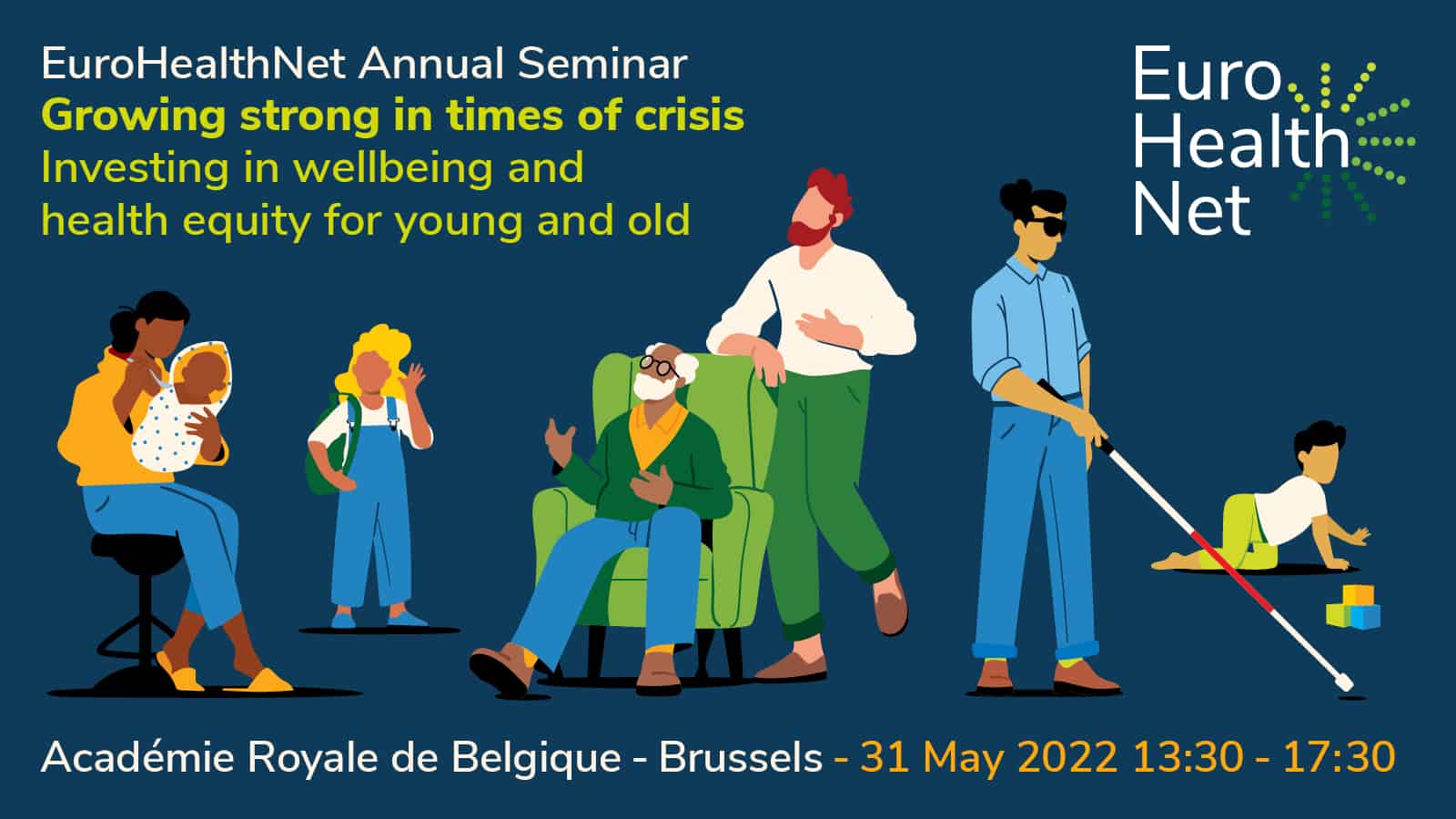
EuroHealthNet Annual Seminar: Growing strong in times of crisis

EuroHealthNet Annual Seminar: Growing strong in times of crisis

Investing in wellbeing and health equity for young and old

Our societies are currently at a crossroads. Demographic change, growing inequalities, the climate crisis, COVID-19, and the impacts of the war in Ukraine are all having a negative impact on the health and well-being of our societies. These challenges are straining public resources and the social fabric of our communities. How can we overcome these issues and grow stronger in times of crisis?  

We must prioritise health equity and wellbeing among children, youth, families and older people to ensure they have the essential conditions and resources to thrive, setting them up for lifelong health and wellbeing. Alternative economic and care models, such as the Economy of Wellbeing – as well as socially-conscious public and private investments offer the potential to grow stronger and more sustainably out of the current crises.

This in-person seminar will gather experts and policy makers to explore the necessary conditions in which all members of society, including young and older people, feel like capable and valued members of their immediate and wider communities. New and innovative approaches and investments will be presented, in the context of current European policy developments, and with a critical focus on their impacts on health equity. Discussions will be centred around the following themes:

  • Securing conditions for health equity and wellbeing in childhood and adolescence in times of uncertainty    
  • Prioritising public investments for healthy and active ageing in the wake of multiple crises
  • Exploring how we can turn our current uncertainties into opportunities for strength, through concepts like the Economy of Wellbeing

Date: 31 May 2022

Time: 13:30-17:30 CET

Venue: In person meeting at the Royal Academy of Science, Letters and Fine Arts of Belgium

More information

Posted by Didier in News
UNESCO Chair Global Health & Education and JOGG: joining forces for a Lifestyle Transition

UNESCO Chair Global Health & Education and JOGG: joining forces for a Lifestyle Transition

Press release – The UNESCO Chair Global Health & Education and JOGG are combining forces to put a Lifestyle Transition on the agenda of national and international policymakers. A Lifestyle Transition for and together with today’s young people. A healthy future demands cross-domain cooperation focused on creating a healthy environment and a healthy lifestyle. Something which does not end at national borders.

Unhealthy environment

A healthy future begins with a healthy younger generation. Among children and young people who grow up in a healthy environment. But at the moment that environment is far from healthy. Everywhere children go they are constantly being bombarded with messages to eat both unhealthy food and too much of it, while they enjoy less and less physical exercise. On top of which the differences in health between those from poorer backgrounds and those who are better off, are only growing. The result has been a huge increase in diseases of affluence, including among children. Together with all the adverse effects that this has, both for the individual and for society.

Joined action for a Lifestyle Transition

“The present lifestyle crisis demands action. Action to narrow the health gap and improve the health and wellbeing of children and young people,” says JOGG director, Marjon Bachra. “We need to move towards a society where being able to have a healthy lifestyle is the norm. But we can only achieve that by taking a holistic approach. One which embraces all domains and sectors. Something on which both JOGG and the UNESCO Global Health & Education Chair agree. It is high time for a Lifestyle Transition.”

From today JOGG and the UNESCO Chair will support one another on the road to creating a healthier society, both nationally and internationally. The active involvement of children and young people themselves plays an important part in this. For example, the JOGG Youth Health Community is supporting the UNESCO Chair with an international project aimed at actively involving young people in creating a world which is healthy and pleasant to live in. Not just because participation is their fundamental right, but because it is also vital if the interventions to improve health are to be effective.

About JOGG – Healthy Youngsters with a Healthy Future

JOGG is a driver of the Lifestyle Transition in the Netherlands. The organisation has developed and facilitates a worknet which connects more than 200 Dutch municipalities and roughly a hundred other partners in society, fundamental and applied research and the business community. It is described as a ‘worknet’ because all the parties are working to achieve this. Based on the integrated JOGG approach, together they are working to create a healthier environment for the young, in policy and in practice. An environment in which it is easy to eat healthy food, get sufficient exercise and relax.

About the UNESCO Chair for Global Health & Education

The UNESCO Chair for Global Health & Education is a UNESCO Chair associated with the Clermont Auvergne University in France, with Professor Didier Jourdan as chairholder and Goof Buijs as manager. The UNESCO Chair works globally to strengthen health promotion and disease prevention, targeted mainly towards young people and aimed at lifelong learning. The emphasis is on creating the right conditions whereby children and young people can take more control of their own lives, as individuals, as members of their community and as world citizens.

Posted by Didier in News
UNICEF report: Preventing a lost decade

UNICEF report: Preventing a lost decade

Two years into the pandemic, the widespread effects of COVID-19 continue to worsen, increasing poverty and deepening inequalities. While some countries are recovering and rebuilding a ‘new normal’, for many, COVID-19 remains a crisis. The human rights of children around the world have not been so threatened for more than a generation.

The global response so far has been very uneven and inadequate. The world now stands at a crossroads. The actions taken today will determine the well-being and rights of children for years to come.

As UNICEF celebrates its 75th anniversary, the report “Preventing a lost decade. Urgent action to reverse the devastating impact of COVID-19 on children and young people” takes stock of the effects of the ongoing impact of  COVID-19 on children and outlines the road to respond and recover to reimagine the future for every child.

For more information and to download the report (available in English, French, Spanish, Arabic)

Posted by Didier in News
Concise Guides to the Sustainable Development Goals – SDG 3 Good Health and Wellbeing

Concise Guides to the Sustainable Development Goals – SDG 3 Good Health and Wellbeing

The Concise Guides to the UN Sustainable Development Goals series consists of 17 short books, each examining one of the UN Sustainable Development Goals. The series provides an integrated assessment of the SDGs from an economic, legal, social, environmental and cultural perspective.

The guide on health and well-being[i] addresses the various contemporary issues related to the implementation of SDG3 and provides a concrete analysis of the challenges. Written by global experts in the field, the book mobilises the concepts of health, well-being and sustainable development and puts them into perspective through essays and case studies in a variety of contexts. It provides a landscape of research, developments, innovative interventions and long-term visions for SDG3.

Chapter 7[ii]  is specifically dedicated to the Health Promoting Schools approach and the implementation of health promoting learning environments in different regions of the world. It recalls the importance of developing valid and effective frameworks for school-based interventions, anchored in an intersectoral perspective, and the role played in this respect by the UNESCO Chair Global Health & Education.


[i] [i]  Savelyeva, T., Lee, S. W., & Banack, H. (Éds.). (2019). SDG3 – Good Health and Wellbeing : Re-Calibrating the SDG Agenda: Concise Guides to the United Nations Sustainable Development Goals. Emerald Publishing Limited. https://doi.org/10.1108/9781789737097

[ii] Lee, A.Young, I.St Leger, L.Jourdan, D. and Kolbe, L. (2019), “Implementing a Healthy Environment for Teaching and Learning Through Health–School Partnership”, Savelyeva, T.Lee, S.W. and Banack, H. (Ed.) SDG3 – Good Health and Wellbeing: Re-Calibrating the SDG Agenda: Concise Guides to the United Nations Sustainable Development Goals, Emerald Publishing Limited, Bingley, pp. 125-149. https://doi.org/10.1108/978-1-78973-709-720191011

Posted by Didier in News
5th UNESCO Forum on Transformative Education for Sustainable Development, Global Citizenship, Health and Well-being

5th UNESCO Forum on Transformative Education for Sustainable Development, Global Citizenship, Health and Well-being

From 29 November to 1 December, UNESCO brought together experts in education for sustainable development, global citizenship and, health and well-being to discuss good practices, progress, monitoring and mainstreaming of transformative education towards target 4.7 of the Sustainable Development Goals (SDG).

Transformative education involves the teaching and learning oriented to motivate and empower learners to take informed decisions and actions at the individual, community and global levels. It emphasises the complementarity and synergy between various educational programmes and approaches that have contributed to improving the quality and relevance of education and learning. It calls for an integrated approach to target 4.7 of the SDGs, to pave the way for innovation in education today.

Didier Jourdan gave a keynote lecture on: “Creating safe, inclusive and healthy learning environments”.

More information

Recordings of the live stream of the Forum

Posted by Didier in News