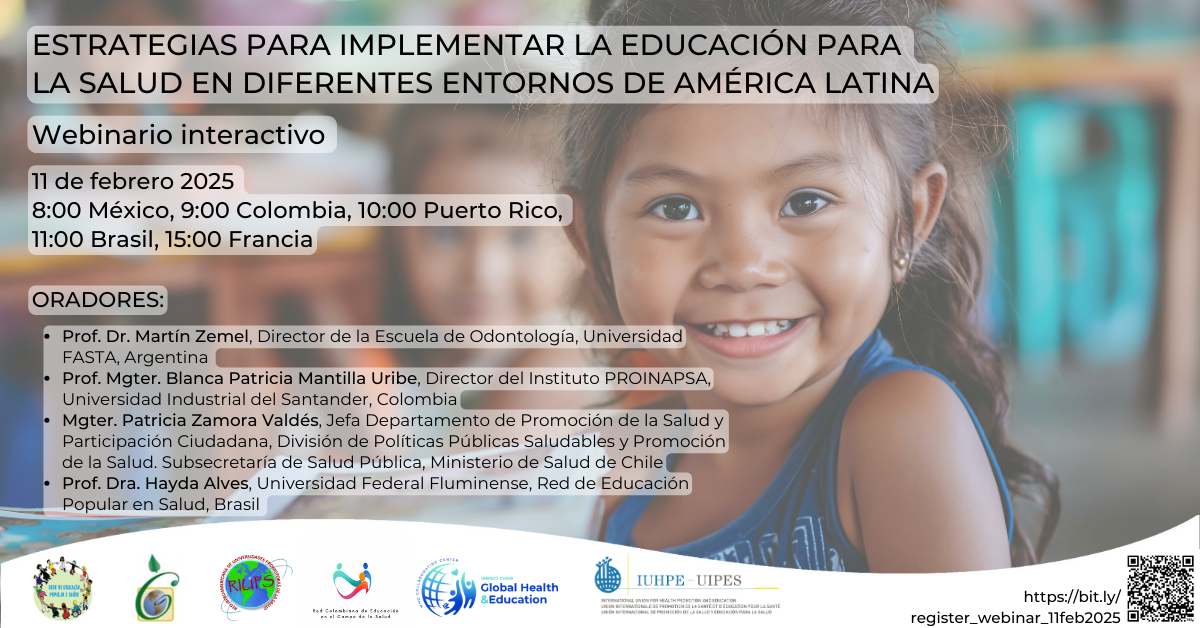
Time: 8.00 (Mexico), 9.00 (Colombia), 10.00 (Puerto Rico), 11.00 (Brasil), 15.00 (France)
Register: Registration is free. The link to the webinar will be sent to you after registration.
Language: The webinar will be held in Spanish and Portuguese. Translation will be available in 50+ languages, including English, French, Portuguese and Spanish. We will use a translation app based on AI.
Información en español, Informações em português
Summary
Our Network promotes the strengthening of education in the field of health in Latin America. This is why we consider it essential to review the strategies implemented, as well as to recognise the pedagogical perspective that underpins them. This implies transcending the biomedical and instrumental approach and promoting an education that not only transmits knowledge, but also fosters critical thinking, active participation and the emancipation of communities.
We propose an education for health that is transdisciplinary and dialogical, and that integrates both academic knowledge and popular and ancestral knowledge. It is not only about providing information, but also about generating learning spaces that empower people and enable them to actively participate in the transformation of their communities, strongly marked in the Latin American context by the presence of the Social Determinants of Health and their consequent health inequities.
Reviewing current strategies in Latin America will be key to promoting Health Education that responds to the real needs of communities and increases their collective participation in health.
The questions that we will address during the webinar are:
- What are the experiences that are being carried out in the field of Health Education in different countries in Latin America?
- What are the strengths and opportunities for Health Education?
Speakers
Speakers are:
- Prof. Dr. Martín Zemel, Director of the School of Dentistry, Universidad FASTA, Argentina
- Prof. Mgter. Blanca Patricia Mantilla Uribe, Director of the PROINAPSA Institute, Universidad Industrial del Santander, Colombia
- Mgter. Patricia Zamora Valdés, Head of the Department of Health Promotion and Citizen Participation, Division of Healthy Public Policies and Health Promotion. Undersecretariat of Public Health, Ministry of Health of Chile
- Prof. Dr. Hayda Alves, Network of Popular Health Education, Brazil
Latin American Network for the Revitalisation of Health Education
This webinar is a part of the “Latin American Network for the Revitalisation of Health Education”. This initiative is being promoted with the participation of the UNESCO Chair on Global Health and Education, the Inter-American Consortium of Universities and Training Centers for Health Education and Health Promotion (CIUEPS), the Brazilian Network of Popular Health Education, the Colombian Network of Health Education and the Regional Office for Latin America of the International Union of Health Promotion and Education (IUHPE/ORLA), with the following objectives:
- Promote health education at national and international levels, as a fundamental dimension of the health disciplines, the educational sciences and the social and human sciences.
- To recuperate the Latin American production and position it in the regional level, which implies promoting its critical and decolonial approaches. A health education that advocates for social transformation towards a more just and equitable society that guarantees well-being and a life with dignity.
- Promote the articulation of the education and health sectors to strengthen the actions of each of these sectors to promote health education, by recognizing education and health as two inalienable, synergistic and interdependent human rights.
- Strengthen the theoretical, political and ethical foundations of health education as a requirement for a responsible, productive and ethical pedagogical practice.
- To generate a setting for the articulation of academia and civil society that allows Latin American integration in order to share experiences, knowledge and aspirations framed in a collective purpose.
- To promote national and international integration with respect to health education as a means for mutual learning and solidarity, and to facilitate cooperative actions in the development of academic-scientific events, research and training processes.
The webinars, open to all interested stakeholders, are a component of the program. They are experiential sessions, lasting 60-90 minutes, with guest speakers who present their reflections on two or three problematic questions to encourage audience participation. Five webinars have been scheduled for this first stage of the program, with an interval of 2 months between each one.
Watch the recordings of previous webinars:

 About Didier Jourdan