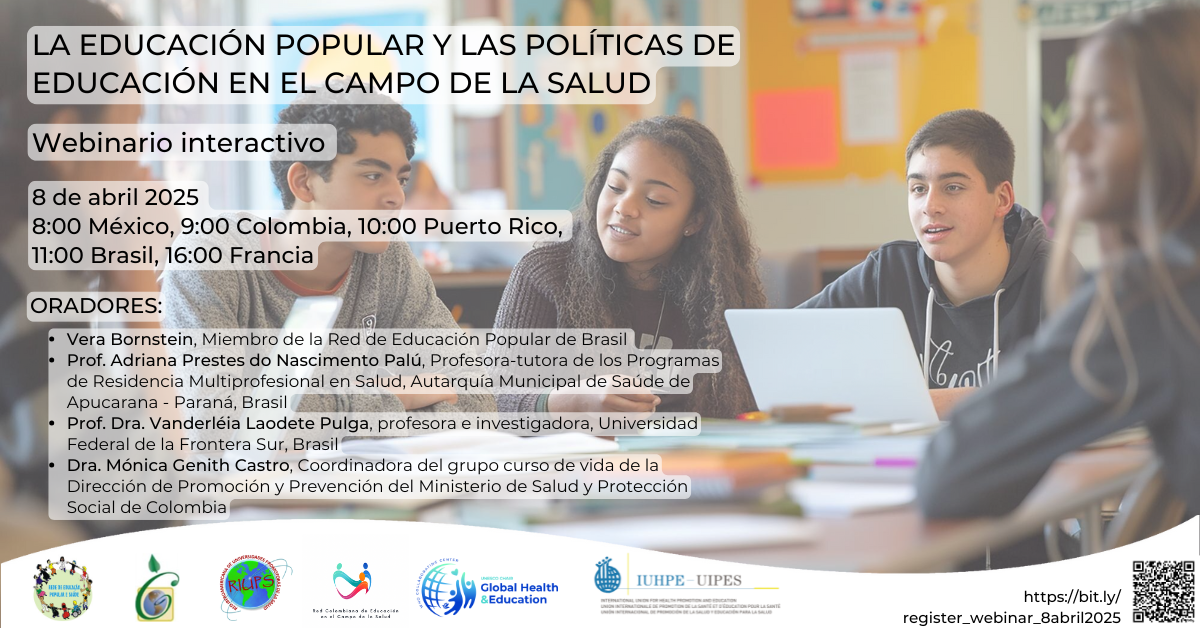
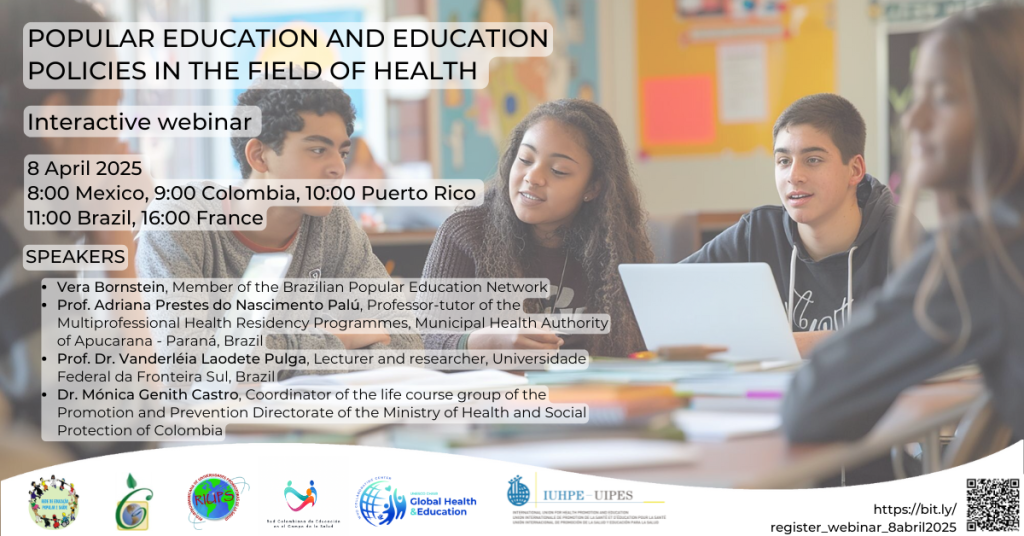
Time: 8.00 – 9.30 Mexico, 9.00 – 10.30 Colombia, 10.00 – 11.30 Puerto Rico, 11.00 – 12.30 Brazil, 16.00 – 17.30 France
Language: The webinar will be held in Spanish and Portuguese. Translation will be available in 50+ languages, including English, French, Portuguese and Spanish. We will use a translation app based on AI.
Registration: Register here. Registration is free. The link to the webinar will be sent to you after registration.
Información en español, Informações em português
Speakers
Moderator
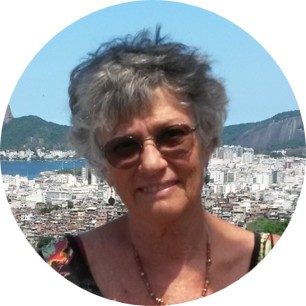
Vera Bornstein, Member of the Brazilian Popular Education Network
Prof. Adriana Prestes do Nascimento Palú has a degree in Dentistry and a Master’s degree in Collective Health. She is currently an official of the Municipal Health Authority of Apucarana – Paraná, where she is director of the Department of Health Education and Research and coordinator of the Multiprofessional Residency Commission. She is the state coordinator of the Training Programme for Popular Health Agents (AgPopSUS) and of the Improvement Course in Popular Health Education (EdPopSUS), and is a member of the National Articulation of Movements and Practices of Popular Education and Health – ANEPS, of the Popular Education Network and of the National Movement of Health Residencies.
Prof. Dr. Vanderléia Pulga, Bachelor in Philosophy, Master and Doctor in Education, winner of 1st place in the Research and Systematisation category in the 2nd edition of the Victor Valla Award, Professor of Collective Health at UFFS/Campus Passo Fundo/RS in the undergraduate course of Medicine. Vice-coordinator of the Multiprofessional Health Residency Programme. Member of the Innovation in Collective Health Research Group. Researcher and guest lecturer of the International Network of Education and Research in Education and Work in Health Systems and Services (RED SALUD UNICA) and of the Master’s and Doctorate Programme in Public Health of the Catholic University Redemptoris Mater (UNICA) and of PAHO. Member of the Popular Education and Health WG of ABRASCO. Member of the Brazilian Association of Rede Unida. Member of the National Articulation of Movements and Practices of Popular Education and Health.
Dr. Monica Genith Castro Hernandez, Surgeon and Master in Public Health from the National University of Colombia, Coordinator of the life course group of the Promotion and Prevention Directorate of the Ministry of Health and Social Protection of Colombia.
Summary
The webinar aims to analyse how popular education or part of its pedagogical and political principles have been introduced/assumed in health education policies in different countries of the region. There will be a theoretical introduction on the foundations and principles of popular education and afterwards, two speakers will talk about educational policies and experiences in Colombia and Brazil. The questions we will address during the webinar are:
- How have Latin American countries adopted the perspective of popular education, its pedagogical and political principles, in educational policies in the field of health?
- What training initiatives on popular health education are implemented with community members and health professionals in Latin American countries?
Latin American Network for the Revitalisation of Health Education
This webinar is a part of the “Latin American Network for the Revitalisation of Health Education”. This initiative is being promoted with the participation of the UNESCO Chair on Global Health and Education, the Inter-American Consortium of Universities and Training Centers for Health Education and Health Promotion (CIUEPS), the Brazilian Network of Popular Health Education, the Colombian Network of Health Education and the Regional Office for Latin America of the International Union of Health Promotion and Education (IUHPE/ORLA), with the following objectives:
- Promote health education at national and international levels, as a fundamental dimension of the health disciplines, the educational sciences and the social and human sciences.
- To recuperate the Latin American production and position it in the regional level, which implies promoting its critical and decolonial approaches. A health education that advocates for social transformation towards a more just and equitable society that guarantees well-being and a life with dignity.
- Promote the articulation of the education and health sectors to strengthen the actions of each of these sectors to promote health education, by recognizing education and health as two inalienable, synergistic and interdependent human rights.
- Strengthen the theoretical, political and ethical foundations of health education as a requirement for a responsible, productive and ethical pedagogical practice.
- To generate a setting for the articulation of academia and civil society that allows Latin American integration in order to share experiences, knowledge and aspirations framed in a collective purpose.
- To promote national and international integration with respect to health education as a means for mutual learning and solidarity, and to facilitate cooperative actions in the development of academic-scientific events, research and training processes.
The webinars, open to all interested stakeholders, are a component of the program. They are experiential sessions, lasting 60-90 minutes, with guest speakers who present their reflections on two or three problematic questions to encourage audience participation. Five webinars have been scheduled for this first stage of the program, with an interval of 2 months between each one.
Watch the recordings of previous webinars:
- 11 February 2025 – Strategies for implementing Health Education in different Latin American settings
- 26 November 2024 – The invisibilization of health education and how it can be revitalized, also recovering Latin American experiences and productions
- 17 September 2024 – Theoretical and political debates on Health Education in Latin America

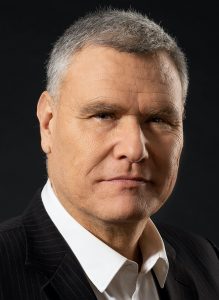 About Didier Jourdan